Lesson 5: EM SC 240N Lesson 5 Review
Overview
The purpose of this lesson is for you to review key concepts from Lesson 5 (Rhetorical Analysis) in EM SC 240N. I strongly encourage you to at least browse through Lesson 5 [1] of EM SC 240N, though that is not required.
Learning Outcomes
By the end of this lesson, you should be able to:
- define rhetoric, ethos, pathos, and logos;
- analyze claims made in speech, writing, and imagery through the lens of the rhetorical triangle;
- define greenwashing;
- identify the greenwashing content of advertising claims;
- identify lies of commission, lies of omission, and character lies;
- define the term homo economicus; and
- analyze principles of Behavioral Economics.
Lesson Roadmap
| To Read | Lesson 5 Online Content | You're here! |
|---|---|---|
| To Do |
|
|
Questions?
If you have any general course questions, please post them to our HAVE A QUESTION discussion forum located under the Discussions tab in Canvas. I will check that discussion forum regularly to respond as appropriate. While you are there, feel free to post your own responses and comments if you are able to help out a classmate. If you have a question but would like to remain anonymous to the other students, email me through Canvas.
If you have something related to the material that you'd like to share, feel free to post to the Coffee Shop forum, also under the Discussions tab in Canvas.
Rhetorical Strategies
Please read the following sentences, and think about the message(s) each one is giving you. Imagine that you don't know anything about the person who is making the statements other than what you read. Treat each example separately.
- I think solar panels are a wonderful technology, don't you?
- I have been in the energy business for almost 40 years, including 30 in the oil and gas industry. But like you, I'm a cost-conscious homeowner with bills to pay. I've never seen technology as potentially game-changing as solar panels. Those things are going to change the world, and better yet, they will save you money.
- Did you know that Tesla Energy will install and maintain solar panels on your roof for no extra cost? You don't have to lift a finger, and you will end up paying less for electricity than you do now. You can save money and get inexpensive, clean electricity. And all of it is guaranteed by contract! I had them install panels on my house, and couldn't be happier. They'll do the same for you.
- You know, every time I see that old coal-fired power plant I think of all of the innocent children living nearby that are probably having asthma attacks because of the pollution. That's why I added solar panels to my roof.
Each of these statements exhibits an attempt to convince you that solar panels are a good idea, but each in a different way. Think about the language devices employed in each of the sentences. What part of your psyche does it attempt to address? Is it logic, emotion, or something else? Are they obvious attempts to gain your agreement, or do they seem reasonable?
Rhetoric
Each of these sentences uses a different rhetorical strategy. Rhetorical strategies are the subject of this lesson, specifically the rhetorical triangle. At the root of all of this is rhetoric, so let's start there. This is just a quick video introduction - no need to take any notes or anything like that.
About 28 centuries ago, people really admired wisdom. They called it Sophos and people admired it so much they were willing to pay for it. They would hire Sophists to teach them all manner of things particularly law and politics, so the Sophists were traveling teachers and poets who roamed the countryside of Greece, and they taught anyone willing to pay to learn. As time went on, these Sophists became the most effective lawyers and gave advice to those governing the new Athenian democracy.
After a while, however, Socrates and his student Plato brought up the idea that the Sophists were not all that wise. In fact, they argued, what they were good at was structuring their lessons to simply sound wise. In essence, Socrates and Plato said the Sophists spoke so persuasively and so falsely that they could make listeners believe black was white. Also, Socrates and Plato objected to the fact that the Sophists charged for their services while they being both wise and noble dispensed their wisdom for free. They created such an uproar that even to this day the term Sophists is an insult. "You're a Sophist."
Not long after, Aristotle, a student of Plato, finally developed some rules for publicly dispensing wisdom and using language persuasively. He put down all his rules in a book, which he called The Art of Rhetoric. In The Art of Rhetoric, Aristotle separated out the wisdom from the skill needed to dispense it. He wrote down rules for arguing whence it required arguers to be ethical as well as persuasive. Aristotle laid out three appeals: logos, pathos, and ethos. He said the arguer should be logical, appeal to emotion, and build his trustworthiness with the audience by being ethical. He also listed 13 tricks or fallacies to avoid in arguing and laid out the ethics he thought an arguer should have.
Later, the Romans based their concepts on the Greeks. A Roman named Cicero came out with a text in the first century listing five canons of argument: (1) invention - creating ways to be persuasive; (2) arrangement - structuring an argument effectively; (3) style - presenting an argument so as to appeal to emotions; (4) memory - speaking extemporaneously; and (5) delivery - effective presentation. Cicero had so much to say that he put it into five books. When you understand that the Romans were very eager to practice law and politics, you understand why they cared about public speaking and argument enough to need five books.
Cicero's five canons influenced Europe for centuries. All students were taught grammar, logic, and rhetoric. After the Roman Empire fell, rhetoric existed only in the writing of letters and sermons. After a bit, people started preaching, and rhetoric became oral again. During the Renaissance, however, oral rhetoric became very popular once more (that's Shakespeare's time) far beyond preaching. The art of rhetoric became essential to lawyers, politicians, priests, and writers. Anyone who wished to persuade a wide audience sought to train in it, and this continues today.
Now, we've skipped over more than 1500 years of rhetoric and argument, but you have the basics. Today, unfortunately, the word rhetoric has taken on some of the negative connotations of sophistry. People think of it as eloquent speech designed to deceive, especially when politicians are involved. Calling something rhetoric is a pejorative.
And that is the history of argument in just over three minutes
Optional Viewing
Purdue University's Online Writing Lab [2] (OWL) provides a lot of publicly available resources that are designed to help students and others become better writers. They do not allow embedded videos, so please click on the link below if you'd like to watch.
- "Introduction to Rhetoric [3]." Purdue OWL.
Rhetoric/rhetorical arguments are designed to convince an audience of whatever the speaker is trying to say, or as Purdue OWL notes, it is "about using language in the most effective way." You most often hear this when referring to a politician, or at least someone acting politically or disingenuously, for example: "That speech was all rhetoric." When you hear or read this phrase, it is meant in a negative way and implies that the speaker was using language to trick the audience into believing the argument they were presenting. As noted in the video above, this negative connotation goes back centuries. But rhetoric has a few connotations, not all of them negative. It can refer to "the art of speaking or writing effectively," and "the study of writing or speaking as a means of communication or persuasion." These two definitions do not necessarily connote deceit. But it can also mean "insincere or grandiloquent language" (Credit: Merriam-Webster [4]).
So, contrary to popular belief, rhetorical arguments are not always "insincere." That said, in this course, we are most concerned about seeing through rhetoric (rhetoric in the negative sense, that is) to evaluate arguments. Please note that rhetorical strategies can also be deployed visually - for example in images, photos, and video - and audibly. Advertisers do this all the time.
Ethos, Pathos, and Logos
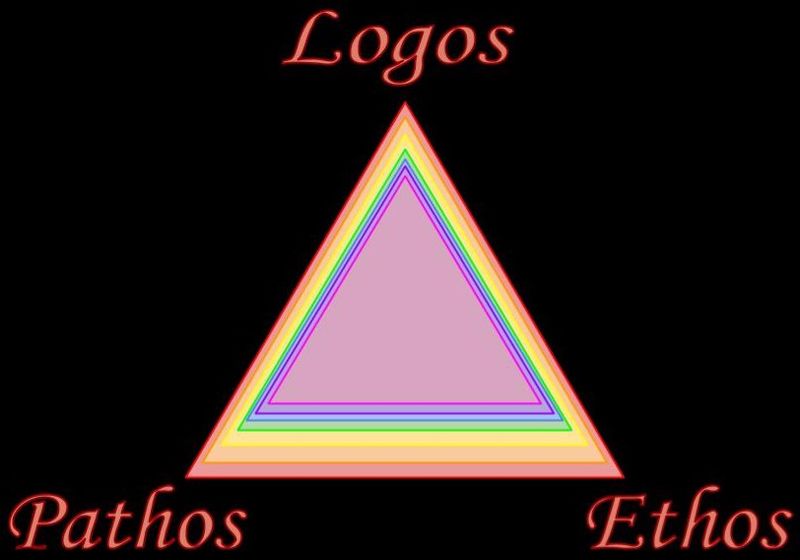
Rhetoric is used to persuade people, and there are three general strategies used to do this: ethos, pathos, and logos. Please watch the video as an introduction to these strategies. We will then go into more detail in each in the following lessons.
Persuasion is an art. Great speakers throughout time have been able to change their listeners' minds and even move their audiences into action through the art of persuasion. Consider these persuasive speakers and how they changed the world through what they said.
For example, JFK in his speech where he said: "Ask not what your country can do for you but what you can do for your country." Or Ronald Reagan, twenty years ago when he said: "Mr. Gorbachev, tear down this wall," or Obama who inspired a nation to believe in hope instead of fear. Nelson Mandela, Gandhi, and even Oprah who persuades people every day to know better and to do better, or how about these leaders: Hitler, Stalin, Jim Jones, who brainwashed his congregation leaving 900 of them unknowingly to their deaths through a mass suicide order? Now, obviously, not all of these speakers are viewed as positive voices of change. These last examples even change the world for the worst, but let's face it: they did it through the art of persuasion.
Now, considering the fact that persuasion can be used for many purposes, it is important that individuals exercise ethical persuasive methods when seeking to persuade an audience. Let's face it: you could get an audience to believe anything you want them to if you have the right facts, a persuasive approach, and sometimes a willing audience. Some people accuse Obama of this, others accuse Rush Limbaugh of the same thing, but the fact remains that both of these men have been persuasive to certain people and groups by using information and motivational appeals. However, presenting facts on only one side of an issue without being transparent about the other side of the issue is sometimes unfair and unethical in seeking to persuade an audience. Think about it: I'm sure you've been on the receiving end of gossip: perhaps someone twisted a truth about you into something that wasn't true because they didn't share the whole truth or the full story. When people use information to make it say what they want it to say without sharing the other side, this can sometimes be considered unethical persuasion. It is important to use information and motive or motivational appeals ethically.
So let's talk about some specific motivational appeals summarized by the Greek philosopher Aristotle thousands of years ago. He believed that to be a truly effective speaker or writer, you had to appeal to three things when giving information to an audience or reader. The first is ethos or credibility. Ethos refers to the way in which a person convinces someone else to believe him or her simply by his or her character, credibility, and trustworthiness. We tend to believe and follow people we can respect. One can often increase ethos by being knowledgeable about your topic so that you have the authority and right to speak on the subject matter you are presenting. Another way to increase ethos is to appear thoughtful, fair, and respectful of alternative points of view. Your accuracy and thoughtfulness in crediting your sources, professionalism, and caring about your speech and its structure, your proper use of grammar, and your overall personal neatness are all part of the appeal to ethos.
The second motivational appeal described by Aristotle is pathos. Pathos refers to persuading by appealing to an audience's emotions, values, and beliefs. Word choice affects the audience's emotional response, and emotional appeals can effectively be used to enhance persuasion. This means that your speech should not only be someone else's words or research. You must tie together your research by crafting your speech with your own words in a way that is persuasive and interesting for your audience.
The third emotional appeal is logos. As you may assume from the term, logos is an appeal to reason or logic. This will be the most important technique you will use in your persuasive speech, and it was Aristotle's favorite. It includes the internal consistency and clarity of your speech. It requires that you make a claim and use quality reasons and evidence to support your claim. Just like a lawyer crafts his or her argument with a logical flow that appeals to the minds of the jury, so too must you put together a speech that has a logical flow of persuasion. Giving reason is the heart of persuasion and cannot be emphasized enough. You simply cannot and should not seek to persuade without strong information and a strong logical flow of that information.
Using ethos or credibility, pathos or emotional appeals, and logos or logic is important for any persuasive speaker. If you're seeking to truly persuade an audience, it's important to have all three: like one leg missing from a three-legged stool would cause the stool to collapse, so will your argument or persuasion collapse if you're missing one of these important motivational appeals. Remember, persuasion is not just standing in front of an audience and rattling off facts in hopes that your information will get an audience to change. The speaker must play an active role in persuasion. You are part of your persuasive message and your credibility, emotional appeals, and logic are important when preparing your speech.
So, good luck as you prepare to persuade. Changing minds, hearts, and actions isn't easy, but with the right attitude and preparation, you can succeed. Prepare for your own success and have fun while doing it.
Optional Reading
Purdue University has an excellent online writing lab. It has a lot of very helpful information, including how to use rhetorical strategies.
- "Ethos, Pathos, and Logos Definitions and Examples [5]," PathosEthosLogos.com
- "Using Rhetorical Strategies for Persuasion [6]," Purdue University Online Writing Lab
Good to Know
Ethos, pathos, and logos are rhetorical strategies, but these are not rhetorical devices. Rhetorical devices are specific methods that can be deployed to make a persuasive argument, whereas rhetorical strategies are general strategies. You have likely picked up on many of these devices when listening, reading, or speaking. Politicians are particularly fond of them. The "Mental Floss" website [7] goes over some of them. If you Google around, you will find more.
Ethos
Two of the previous sources provide concise definitions of ethos:
- Purdue OWL defines ethos as "the ethical appeal...based on the character, credibility, or reliability of the writer" (Credit: Purdue Online Writing Lab [6]).
- Pathosethoslogos [5]notes that ethos is "ethical appeal, means to convince an audience of the author’s credibility or character. An author would use ethos to show to his audience that he is a credible source and is worth listening to."
Purdue provides the following examples of ways that you can establish ethos. I highlighted a few things that are most important to consider:
- Use only credible, reliable sources to build your argument and cite those sources properly.
- Respect the reader by stating the opposing position accurately.
- Establish common ground with your audience. Most of the time, this can be done by acknowledging values and beliefs shared by those on both sides of the argument.
- If appropriate for the assignment, disclose why you are interested in this topic or what personal experiences you have had with the topic.
- Organize your argument in a logical, easy to follow manner. You can use the Toulmin method of logic or a simple pattern such as chronological order, most general to the most detailed example, earliest to the most recent example, etc.
- Proofread the argument. Too many careless grammar mistakes cast doubt on your character as a writer.
Pathosethoslogos provides the following advice:
Ethos can be developed by choosing language that is appropriate for the audience and topic (also means choosing proper level of vocabulary), making yourself sound fair or unbiased, introducing your expertise or pedigree, and by using correct grammar and syntax."
There are many ways to establish ethos (credibility) with your audience. Some of the most common are listed above, but there are others. What it boils down to is that whether you are speaking, writing, or trying to communicate in any way, anything you do to try to convince your audience that you are a credible, reliable source of information, is ethos. Any time that someone is trying to establish credibility, they are using ethos.
Okay, now let's get back to our original examples. Which of these sentences relies the most on ethos, and why do you think so?
- I think solar panels are a wonderful technology, don't you?
- I have been in the energy business for almost 40 years, including 30 in the oil and gas industry. But like you, I'm a cost-conscious homeowner with bills to pay. I've never seen technology as potentially game-changing as solar panels. Those things are going to change the world, and better yet they will save you money.
- Did you know that Tesla Energy will install and maintain solar panels on your roof for no extra cost? You don't have to lift a finger, and you will end up paying less for electricity than you do now. You can save money and get inexpensive, clean electricity. And all of it is guaranteed by contract! I had them install panels on my house, and couldn't be happier. They'll do the same for you.
- You know, every time I see that old coal-fired power plant I think of all of the innocent children living nearby that are probably having asthma attacks because of the pollution. That's why I added solar panels to my roof.
If you said the second example, then give yourself a pat on the back. The language used in that narrative is a clear attempt to establish the author's credibility, in a few ways.
- First of all, saying that "I have been in the energy business for almost 40 years" is meant to be a strong indication that I know energy. This is an attempt to establish credibility. If the person said that they were an accountant for 40 years or a recent college grad with a History degree, would it have the same impact?
- The assertion that the person worked in the oil and gas industry is a more subtle attempt to establish credibility because the renewable and non-renewable industries are usually competitors. The impact of the statement would probably be different if they said they worked in the solar industry, or if you knew they sold solar PV systems.
- The third attempt at ethos is made when the person tries to establish common ground with the reader by stating they are a cost-conscious homeowner (this strategy is pointed out by the Purdue article).
Remember, any way that a speaker or writer can establish credibility and believability is ethos. There are myriad ways of doing this, including using appropriate language, citing legitimate sources of information, dressing appropriately, speaking/writing with confidence, avoiding grammatical and/or spelling errors, and more.
So, now that we have ethos figured out, here's a little curveball: Appeals to ethos can change from situation to situation, even if it is the same speaker or writer trying to convey the same message. The video below from our friends at Purdue University does a really good job of explaining this and goes over ethos in general as well.
Optional Viewing
- The video creator does not allow the video to be embedded in other websites, so please click on this link to watch the video [9].
The narrators sum up ethos nicely by stating that: "In every rhetorical situation, ethos means a quality that makes the speaker believable." This "quality" can and does change all the time. Even if you don't have the credentials that render you credible on the topic, you should do your best to establish credibility by doing things like using reliable sources, proper language, and so forth. You've probably heard the truism that as a speaker or writer you need to "know your audience." Establishing ethos is one of the reasons why. You want your audience to believe you, and ethos can help make that happen. Politicians are particularly (or notoriously, depending on whom you ask) good at doing this. An example of this can be seen below.


Notice the stark difference in physical appearance in the photos of Barack Obama above. What messages is he sending with regards to ethos? The left photo shows the classic "sleeves rolled up" look, which politicians use to speak to "regular folks," usually in public settings like fairs, construction sites (they'll also don a hard hat for this), local restaurants, and so on. The ethos-related messaging is something like: "Hey, I'm just a regular, hard-working guy like you. I understand your problems." But by wearing a dress shirt instead of, say, a polo shirt, an air of authority and professionalism is still presented.
The photo to the right presents a much different attempt at ethos. He is projecting an image of power and authority by wearing a suit and tie, being the only person in the shot, and sitting in a well-appointed office. Even his posture is different than the other photo. Note that both an American flag and flag with the Presidential Seal is in the background. Both project authority, among other things. Do you notice anything else in the background? Do the family pictures convey a message? This is a subtle reminder that he has a family with two young children, and thus is relatable (this is probably also an example of pathos).
One Final Note
It can be easy to view ethos as a way to "trick" audiences into being persuaded by someone. This can certainly happen and often does. This is a common problem with politicians, as they never want to appear not credible. But it is important for you to know that ethos can be legitimately established. Knowing as much as possible about the source of information is an important aspect of determining credibility. For example, if I want to know about drought conditions across the U.S. [12] I refer to the National Oceanic and Atmospheric Administration (NOAA) [13] since I know that monitoring water conditions is one of their focuses and that they are tasked with presenting an unbiased, scientific perspective. In short, I know that they are credible.
If the Administrator of NOAA [14](one had not been confirmed yet [15], as of September 2018) was to give a speech or write an article, (s)he would be remiss if (s)he did not let the audience know her/his position. (S)he has credibility, but still may need to establish ethos. Doing this does not mean that (s)he is trying "trick" anyone, but it does mean that (s)he is trying to strengthen her/his argument, which if you recall is the purpose of rhetoric. Ethos is only established if the audience thinks that you and/or your argument, is credible, and that can be done without being dishonest or "tricky" in any way.

Check Your Understanding
Describe one specific example of something that could establish OR compromise ethos, depending on the audience.
There are many possible examples. One really prominent one that comes to mind is that just being Donald Trump or Barack Obama will bring a very strong positive or negative reaction, depending on who is in the audience. Me having long hair and a beard can compromise my ethos in certain circles (e.g., with police officers or other authority figures), but can help establish it in others (e.g., at music festivals).
Pathos
Please watch the commercials below before continuing.
This Commercial shows a man with a baby driving around the McDonald's drive-thru early in the morning. Instead of stopping at the drive-thru window as someone would normally do, the man continuously drives around the McDonald's in the drive-thru lane without stopping. The reason that he does this is because there is a sleeping baby in the back seat, and he does not want the baby to wake up. The McDonald's employees don't understand what is going on at first, but eventually, they catch on and try their best to help him. The steps the employees take to help them include talking really fast and quietly into the intercom when the man drives by the intercom and making a sign that shows his total at the front of the store so he can see it as he drives by. Eventually, the employees make his order, and he swaps it really fast with the money that he uses to pay for the order. He then fist pumps in front of the restaurant before he drives back onto the road.
This commercial begins by showing a man getting his mail. It also shows a guy working on a cable line that takes off his sunglasses to reveal that he is a robot. Once he takes his mail inside he pulls out his cable bill. He tries to pull his bill out of the envelope, but the bill is very long and continuously comes out by itself. The man is noticeably startled by this. The commercial then cuts to a woman in bed woken up by an alarm. She then picks up the phone and begins crying into it. She then grabs the phone and rips it from the wall where it is plugged in and throws it on the floor and begins hitting it and crying. The commercial then cuts to a screen that says "It's time for better TV," and then it cuts to a screen that says PlayStation Vue.
This video shows how children copy adults no matter what they do. The video starts out with more harmless things and then it gradually gets to very concerning, evil things. The video starts out showing a little girl copying and following an older man talking on his phone while walking. Then it shows a woman with another little girl copying her on a payphone. Next, it shows a man waiting for the train with a little boy copying him. After that, it shows a woman going up an escalator smoking a cigarette with a little girl following her also smoking a cigarette. Then it shows a man drinking and then littering with his can and a little boy follows and does the same thing. Later, it shows a girl stumbling in an alleyway about to throw up with a little girl following her and copying her. After that, it shows a woman sticking her middle finger up at another driver while driving and a little boy in the back seat is also sticking up his middle finger at the other driver. Then it shows a man pointing and yelling at a dry cleaner employee and a little boy next to him does the same thing. After that, it shows a man and a little boy throwing rocks at an animal. Then it shows a woman and a little girl drunkenly yelling at a baby in a crib. Finally, it shows a man getting into an argument with a woman that turns physical, and the video stops as the man and a little boy following him are about to throw a punch. The video then says "Children See, Children Do", and then it shows a man helping another woman pick up her things after dropping them. The screen then reads "make your influence positive, "and then the commercial ends.
What was your reaction to each of these videos? Was your reaction to each similar in any way? Different? If you have not already, take a moment to think about how each commercial tried to persuade you through its emotional content.
Optional Viewing
Please click on the link below for an explanation of pathos.
- Video Explanation of pathos [18] from Purdue University Online Writing Lab
As noted in the video, pathos can be defined as "the emotional quality of the speech or text that makes it persuasive to the audience." Though most often associated with sympathy, sadness or similar "sad" emotions, pathos can utilize the full range of human emotion, including anger, joy (e.g., through laughter or inspiration), frustration, suspicion, curiosity, scorn, repulsion, jealousy, desire, compassion, hope, love, and more.
Please take a few minutes and think about all the ways that the commercials at the top of the page attempt to elicit an emotional response. Do these attempts make the commercials more persuasive? Why or why not?
The McDonald's commercial uses one of advertising's favorite pathos tools - the baby [19]. Babies tend to elicit all kinds of positive emotions - e.g., happiness, sympathy, love, and compassion. When in doubt, find a way to put a baby (or puppy) in your advertisement! (No, seriously. Next time you see some advertisement, see how often a baby or puppy appears.) The commercial also uses humor and (for parents, anyway) empathy. Even the music evokes pathos. Note that the baby is essential to the plot of the commercial, but I submit that (s)he has absolutely nothing to say about whether or not I should eat at McDonald's. Pathos does not need to be logically consistent with the rest of the work. It is meant to play on the audience's emotion(s). This is one thing that distinguishes the first ad from the second.
The second ad uses kind of an odd mixture of suspense, dread, and humor to get its point across. The humorous aspect in and of itself has little connection to the product. (It should be noted that there is some humor in the first commercial as well, e.g., the girl hurriedly sliding over the counter in the middle of it.) However, the negative emotion created by the man's reaction to the cable bill and the woman's to the telemarketer could be said to have a direct connection to the real-life experience of issues related to cable TV. Of course, this is all seriously overdramatized (at least for me, but I suppose everyone reacts to their bills in their own way), but milder versions of the emotions expressed are not far-fetched.
The third ad uses pathos (sympathy, sadness, anger, etc.) to get its point across, but the pathos is very much consistent with the message of the video. Speaking for myself, the imagery used in the third video makes it much more impactful than an article providing statistics about how parents' behavior can negatively impact children. In other words, the pathos served its purpose.
I consider the pathos in the McDonald's ad to be "fake pathos," which was described in the video from Purdue. From my perspective, the McDonald's ad is a clear attempt at emotional manipulation (though I don't think they want the viewer to think that), and thus compromises the ethos of the company because it calls into question their credibility. Call me a cynic, but I don't think that the goal of making the ad was to spread joy and laughter. As the folks from Purdue mentioned, that is the risk you run if your pathos is not genuine. The Sony commercial is overdramatic, but it's so "over the top" that it's quite clear that it is done in jest and (again, speaking for myself) does not compromise ethos. Regardless of how genuine or fake the pathos is, it is still used to create an emotional response. To a large extent, the impact on ethos is subjective.
Pathos in Writing
Pathos is the most commonly used rhetorical strategy in advertising (both print and video) because it is often relatively easy to do with imagery. See below for an interesting example from the World War II era.

Pathos can also be conveyed in writing. As noted in the video, this often boils down to word choice, in particular, adjective choice. In fact, word choice often provides the reader with insight into the motivations of a writer.
Suggested Reading
The two articles below are about the same issue - the revised "Clean Power Plan [21]" announced by the Obama Administration in August of 2015, which has since been revoked by the Trump Administration. This plan was designed to reduce CO2 emissions from power plants in an effort to "take real action on climate change" by requiring states to meet emissions standards set by the federal government. This would impact some states more than others - states who get a high percentage of their electricity from coal would be particularly impacted. As you can well imagine, this is not without controversy. When reading the articles below, pay special attention to word choices that can elicit emotion, especially when other, more neutral words could have been used. Note that both are from reputable websites, but that both are opinion pieces.
- Climate-Change Putsch [22]," Wall Street Journal (the article is unattributed, but it appears it was written by the Editorial Page Editor Paul Gigot). This was accessed via Kentucky Industrial Utility Customers [23].
- "Obama Administration Issues 'Strong and Smart' Final Clean Power Plan - Biggest U.S. Carbon Emission Reduction Measure in History [24]," by Ken Kimmell, President of the Union of Concerned Scientists.
- The pathos flies off the page before the article gets started! Note that the subtitle is "States should refuse to comply with Obama's lawless power rule." The use of the adjective "lawless" is very evocative. It is not necessary to the facts of the article (though it does coincide with the author's opinion), but does set the emotional tone of the article nicely.
- Note the highlighted text. All of these word choices are examples of pathos, meant to "get a rise" out of the reader. Comments are in parentheses: "Rarely do American Presidents display the raw willfulness (meant to elicit disgust at power-hungriness) that President Obama did Monday in rolling out his plan to reorganize the economy (a common conservative talking point, and not a compliment) in the name of climate change. Without a vote in Congress or even much public debate, Mr. Obama is using his last 18 months to dictate (again, suggests power run amok) U.S. energy choices for the next 20 or 30 years. This abuse of power (power monger!) is regulation without representation. The so-called (suggests skepticism) Clean Power Plan commands (power word) states to cut carbon emissions by 32% (from 2005 levels) by 2030. This final mandate is 9% steeper ("higher" or a rephrasing could be used) than the draft the Environmental Protection Agency issued in June 2014. The damage (suggests assault) to growth, consumer incomes and U.S. competitiveness will be immense (especially strong adjective)—assuming the rule isn’t tossed by the courts or rescinded by the next Administration."
- More highlights: "States have regulated their power systems since the early days of electrification, but the EPA is now usurping this role to nationalize (suggests power-grab by the government; suggestive of socialism) power generation and consumption. To meet the EPA’s targets, states must pass new laws or regulations to shift their energy mix from fossil fuels, subsidize alternative energy, improve efficiency, impose (suggests forcing against one's will) a cap-and-trade program, or all of the above. Coal-fired power will be the first to be shot (suggests violence), but the EPA is targeting all sources of carbon energy. As coal plants have retired amid seven years of EPA assault (violent word again), natural gas recently eclipsed coal as the dominant source of electric power. This cleaner-burning gas surge has led to the cheapest and fastest emissions plunge in history, but the EPA isn’t satisfied."
- Other word choices include "central planning," "punishing" states, "bull-rush" states, "distorting the law" beyond recognition, "intimidate" the states, global warming "stampede," and climate change is too important to "abide by relics like the rule of law or self-government."
- “We congratulate President Obama and Administrator McCarthy for their bold and visionary leadership (elicits respect and admiration), and EPA staff for a final plan that is fair, cost-effective, and builds off of proven, successful policies (indicates the correctness of policies) that many states have already put into action."
- “The Clean Power Plan provides us with our best shot (again, implies correctness) to meet our international climate goals and lead (indicates good leadership) the rest of the world towards a strong international climate agreement. This will also be a catalyst for a clean energy economy at home that will benefit all states through a more diverse energy supply, cleaner air, and homegrown job growth."
- “We are pleased the facts (implies that they are correct) about cost-effective (very positive term) carbon reductions won out, as evidenced by the increased role of renewables in the plan. UCS has said all along that rapid growth in renewables is feasible and affordable, a fact that is supported by the shift to clean energy already underway."
- “And as a former RGGI chair, I know first-hand that states can cut carbon pollution and grow their economies far more effectively when they work together rather than if they act alone. With the final rule, EPA encourages states to collaborate, which makes perfect sense (a clear suggestion that they are right) — the electricity market crosses state lines, therefore the best solutions are regional in nature."
- “We also note that the final rule wisely (Hey, they are doing smart things!) includes measures—such as early action credits for investments in renewable energy and an extended initial compliance date—to limit the risks (negative connotation) of a rush to gas. Natural gas is still a fossil fuel, with risks of methane leakage in its production and distribution, therefore a large-scale shift to natural gas will make it more difficult for the United States to make the deeper emission reductions needed by mid-century. The rule also takes significant steps to help low-income communities cut their energy bills and join in the benefits (very positive terminology) of a transition to a low-carbon economy."
Optional Reading
Here is another short article about the Clean Power Plan. See if you can pick up on any use of pathos from the author, or not.
- "Could Obama's Clean Power Plan Lower Your Electric Bill? [25]," by Daniel White, Time Magazine
Was pathos used by the author? The only instances of pathos are used to describe what other people are saying - e.g., "slashing jobs," "driving up prices" - the author himself writes dispassionately about the topic. This demonstrates good reporting, using more ethos and logos (see next section) to persuade the audience.
Optional Activity
Add and/or change some words from the Time Magazine article to evoke more pathos in the following paragraph. Have some fun with it!:
"In a report released last week, public policy professor Marilyn Brown found that boosting renewable energy sources such as wind and solar power would reduce energy costs in the long run as they become more readily available. Even if energy costs did go up in the short run, she argued that would cause consumers to invest more in things like energy-efficient appliances, which would again lead to lower electricity bills over time."
Please note that I am not advocating one opinion over the other on this topic, nor am I saying that either of the authors is telling untruths. I am merely pointing out word choices that convey pathos. Perceptive readers will pick up on such word choices, which may compromise ethos. Pathos can be an effective persuasive technique, but generally only if the reader agrees with the author's arguments. As critical thinkers, you should be skeptical of anyone that uses pathos in such a way that appears to try and persuade you to believe one thing or another, whether or not you agree with the overall point.
Finally, back to the statements at the beginning of this lesson. Which one is most pathos-filled?
- I think solar panels are a wonderful technology, don't you?
- I have been in the energy business for almost 40 years, including 30 in the oil and gas industry. But like you, I'm a cost-conscious homeowner with bills to pay. I've never seen technology as potentially game-changing as solar panels. Those things are going to change the world, and better yet they will save you money.
- Did you know that Tesla Energy will install and maintain solar panels on your roof at no extra cost? You don't have to lift a finger, and you will end up paying less for electricity than you do now. You can save money and get inexpensive, clean electricity. And all of it is guaranteed by contract! I had them install panels on my house, and couldn't be happier. They'll do the same for you.
- You know, every time I see that old coal-fired power plant I think of all of the innocent children living nearby that are probably having asthma attacks because of the pollution. That's why I added solar panels to my roof.
Of course, the last one is the correct choice. The use of children's suffering and in particular the use of the word "innocent" are both meant to elicit pity, and ultimately sympathy. Even if it is true, the statement is unnecessarily emotive. I could have just kept to the facts and stated that said power plant has been shown to cause asthma problems for children. This is a strong reason to be concerned. It is still an example of pathos but does not lay it on quite as thick.
Logos
Logos can be thought of as "the logical quality of a speech or text that makes it persuasive" (Credit: Purdue University Online Writing [26]Lab [27]). Often this is straightforward - when you read, hear or see an argument, ask yourself if it makes logical sense. Is the reasoning sound? Does the author make any unfounded conclusions? Is she confusing cause and effect or coincidence with causality? All of these can contribute to, or subtract from, logos.
Optional Reading/Viewing
The folks at the Purdue Online Writing Lab provide a good explanation of logos.
- An Introduction to Logos [26]. Purdue Online Writing Lab (video)
- Please also read the logos section [6] (stop at "Avoid Logical Fallacies," but you can read on for some insight into extra credit questions) of the OWL's rhetorical strategies introduction.
It is very important to note that logos is not necessarily how logical (sound) or accurate (true) the argument is. It is the attempt at logic made by the way the argument is structured. Of course, a sound and true argument is more likely to establish logos, but it depends on the perception of the audience. Examples of how to establish logos include:
- making a logical argument (whether it is true or not),
- arranging images in a way that makes sense to the reader,
- having a logical flow (beginning, middle, end, e.g.) to a story or sentence, and
- citing outside sources that the audience trusts (this is more ethos, but can establish logos as well because it can make your argument seem more logical).
In short, anything that appeals to the audience's sense of logic (as opposed to emotion or the author's credibility) is considered logos.
As noted in the reading above, two common ways of doing this are through inductive reasoning and deductive reasoning. Inductive reasoning takes a specific example or examples, then assumes that a generalization can be made based on that example or those examples. In other words, inductive reasoning goes from the specific to the general. The following are examples of inductive reasoning:
- Every time I forget to water my cucumber plants during the hot part of the summer, they shrivel up and die. I guess cucumbers need water to survive.
- All the storms I've seen blow in from the west, so all storms must move from west to east.
- I had a friend from Switzerland who was really nice, so all Swiss people must be nice.
- After the Obama Administration gave a guaranteed loan to the solar company Solyndra, it failed and the taxpayers lost money. Therefore, all loan guarantees should be stopped because they will lose money.
Inductive reasoning can be correct or incorrect (the first example above is correct, and the other three are not, by the way) - it is up to the audience to determine whether or not the logic is valid. But inductive reasoning is an attempt at logos, irrespective of its validity. The persuasive effectiveness of logos depends on a myriad of factors and can change from audience to audience. The same goes for deductive reasoning. Deductive reasoning is the application of a general belief, and applying it to a specific example, i.e., it goes from the general to the specific. Some examples of deductive reasoning are below:
- Every time the gas prices drop significantly, sales of SUVs go up. The price of gas is expected to decrease dramatically this year, so sales of SUVs will increase.
- I've seen hundreds of swans, and they've all been white. Therefore, the next swan I see will be white.
Like inductive reasoning, deductive reasoning can be false (neither of the above statements can be verified, but they can certainly be false), even if they are sound. If I've seen hundreds of swans and they have all been white, then assuming that the next swan I will see will be white is sound reasoning based on my experience, but it may be false because there are other colors of swans out there. Again, it is up to the audience to determine whether or not the logic is sound and/or true, but it is an example of logos either way.
Logos Strategies
As is the case for pathos and ethos, the effectiveness of the rhetorical strategy depends on many factors, and can (in fact, often does) change from audience to audience. With logos, sometimes seemingly sound arguments are neither sound nor true. This is referred to as a logical fallacy. Logical fallacies are encountered all of the time, and you may even use them, accidentally or otherwise. Logical fallacies will undermine your persuasiveness if they are found by the audience, and in turn, impact your ethos as well as your logos. The reading from Purdue linked to previously goes over some of these arguments and provides some examples. There are many possible strategies, sometimes known as "logical appeals," to making a logical argument. Some of them can be seen in the reading below.
Optional Reading
Dr. George H. Williams, Associate Professor of English at the University of South Carolina, put together some good examples of logical strategies. Please read the "Logos" section in the reading below.
- Ethos-Pathos-Logos-The-3-Rhetorical-Appeals [28], Dr. George H. Williams
- (Optional) If you have not yet, read through the "Avoid Logical Fallacies [29]" section of the OWL reading. Note the logical fallacies included: slippery slope, hasty generalization, post hoc ergo propter hoc, genetic fallacy, begging the claim, circular argument, either/or, ad hominem, ad populum, and red herring.
Given all of this, which of the examples below are the strongest attempt at logos? Do any of the other sentences exhibit logos?
- I think solar panels are a wonderful technology, don't you?
- I have been in the energy business for almost 40 years, including 30 in the oil and gas industry. But like you, I'm a cost-conscious homeowner with bills to pay. I've never seen technology as potentially game-changing as solar panels. Those things are going to change the world, and better yet they will save you money.
- Did you know that Tesla Energy will install and maintain solar panels on your roof at no extra cost? You don't have to lift a finger, and you will end up paying less for electricity than you do now. There is no better way to save money and get clean electricity for your home. And all of it is guaranteed by contract! I had them install panels on my house, and couldn't be happier. They'll do the same for you.
- You know, every time I see that old coal-fired power plant I think of all of the innocent children living nearby that are probably having asthma attacks because of the pollution. That's why I added solar panels to my roof.
The first sentence is a pretty weak attempt at persuasion. The second example is really just an opinion, with an attempt at ethos. You could say that some attempt was made at logos because the argument is structured in a logical way (self-introduction, demonstrates similarity to you, then offers an opinion). The fourth one is similar in logos to the second one - it has a logical structure - but it is much stronger on pathos. The third example is the strongest. The argument follows a logical flow of statements. Something of an "either/or" argument is presented when the speaker states that "there is no better way to save money and get clean electricity." It's subtle, but inductive and deductive reasoning is used. Because the speaker is happy with their work, it is assumed that everyone will be happy (inductive), including you (deductive).
Check Your Understanding
If you make a true argument with impeccable logic, it will establish logos.
(a) Yes
(b) No
(c) It depends
Greenwashing and The 3 Types of Lies
Optional Viewing/Reading
Watch the video below and see if you pick up on any rhetorical strategies.
The BP ad begins by showing four babies in a car driving down a road. The baby driving looks at the gas gauge and realizes that the gas tank is basically empty. The babies then look for a gas station, but the first two that they pass seem evil and/or broken down. Suddenly, the baby driving points and they see a BP gas station where everything is happy. It then shows "gas stations, a little better, baby" on the screen followed by the BP logo as the commercial ends.
So, what did you find?
Pathos
This commercial is filled with pathos. The babies (are some children?) are meant to evoke happiness/warmth/etc. The song is jaunty and catchy - I don't know about you, but I actually like it. The imagery (other than the "bad" gas stations) is colored with pastels, giving it a very soft look. The BP gas pump is whistling(!) and the kids are smiling after they go to the BP station. There is a small attempt at humor at the end (the "baby" part of "gas stations, a little better, baby"). All of this is pathos.
Ethos
The only thing I could detect was at the end when BP put its brand on the screen "Beyond Petroleum." This is a weak attempt at establishing credibility, and I imagine not purposeful. They do that at the end of every commercial. There is no scientific information or even scientific-sounding information. No people in lab coats or statistics cited. Really, very little in the way of ethos.
Logos
There is not much in the way of logos either. The story does have a logical progression - happy kids run out of gas, pass gas stations with inferior gas, kids refuse the "bad" gas, then find a BP station and end up happy and high-fiving. I know, this story is ridiculous on its face, but it does tell a story with some logic to the structure. BP is also saying that their gas is better, or at least a little better. You could also say that showing wind turbines at the end of the commercial is an attempt to associate renewable energy with BP, so perhaps the audience might think that BP supports wind turbines. This is a bit of a logical leap but could be considered logos.
There are a number of rhetorical strategies being deployed in this commercial, which to be honest, is to be expected. Please note that this is not meant to single out BP - as noted earlier in this lesson, print and video advertising is rife with rhetoric, pathos in particular. But is there anything that does not quite "sit right" with you when watching the video? Does it feel like part of the story is missing? Anything odd about an oil company using so much green imagery?
Greenwashing
Suggested Reading
This article provides a good introduction to what greenwashing is and how to spot it. Please read before continuing.
- "Greenwashing [30]" from Investopedia. Note the examples of greenwashing at the end of this article.
- (Optional) "About Greenwashing [31]." EnviroMedia Social Marketing.
Greenwashing can be thought of as:
- "the use of marketing to portray an organization's products, activities or policies as environmentally friendly when they are not."
- Greenwashing Index adds that it can also include "when a company or organization spends more time and money claiming to be “green” through advertising and marketing than actually implementing business practices that minimize environmental impact."
So, why would a company spend the time and money to convey a green image, and risk being viewed as insincere? As you might have guessed, it's good for business. Investopedia notes that: "The general idea behind greenwashing is to create a benefit by appearing to be a green company, whether that benefit comes in the form of a higher stock price, more customers or favored partnerships with green organizations."
Being (or at least putting on the appearance of being) "green" or sustainable has become a very good marketing strategy. Think about all of the times you've seen the term "green" or "sustainable" associated with a product or process. It is happening in basically all sectors of the economy - food, energy, transportation, housing, business, cleaning products, events, sports stadiums, and even fashion. Business pursuing sustainability is not a bad thing. If we are going to achieve a sustainable future, the business community will have to be on board, if not leading the way. The problem is when a business is using sustainability more as a marketing ploy than a legitimate attempt at addressing sustainability.
So, how do you know if a company is making a legitimate attempt at addressing sustainability? In short: it's complicated. The folks in the Greenwashing Index offer some good suggestions on how to investigate claims (see the "How Do I Spot It?" section in the reading):
- "If you see a green ad, take a look at the company as a whole. Can you easily find more information about their sustainable business practices on their website? Do they have a comprehensive environmental story? Is there believable information to substantiate the green claims you saw in the ad? If not, buyer beware."
- "Google the company name plus the word 'environment' and see what pops up. This is far from scientific, but if consumers or environmental advocates have a beef with the company’s track record, something’s bound to pop up."
- "'I know it when I see it.'...those are words to live by for the consumer and green marketing claims. If you spot a green ad, how does it strike your gut? Does it ring true and authentic, or is it obviously hype? Smart shoppers abound globally, and your own scrutiny of green marketing claims is one more item to throw into your shopping cart."
The best way to fight greenwashing is to become educated about sustainability and take the time to learn about companies.
Optional Reading/Video
The video below illustrates some facts about BP that could be found with a little research.
This video is the same video as what was shown above, but with speech bubbles thrown in that give you some true facts about BP. The speech bubbles are transcribed here. In 1991 BP was cited as the most polluting company in the U.S. So by 1997 we decided to re-brand our name to Beyond Petroleum. But in 1999 we got caught for illegally burning gases and were fined 1.7 million dollars in addition to the 22 million dollars we already owed for the last 6 years. So in 2000, we designed a green and leafy Helios Logo! But we then got fined another 10 million dollars by the EPA for more polluting that year. Therefore, we claimed that we would invest 8 billion dollars in alternative energy pursuits through 2015. This sounded great...as long as we didn't mention grossing over 248 billion dollars a year. We got away with pledging less than 4 percent of an annual budget! And after spending another $200 million on our green PR campaign, the public bought it. We even bought-err- I mean, GOT support from the National Wildlife Federation. So in 2005 we made it into Mother Jones' Top 10 Worst corporations for a pipeline burst in Alaska, and don't forget about the other explosion at a Texas refinery killing 15 and wounding over 100. Yeah, we got fined again in 2009 for another 87 million dollars for failing to correct these safety hazards even after the accidents. We made up for the fines by cutting investments in renewable energy by 30 percent in 2009. Then in April 2010, our green image busted another leak, which was a big one, all over the Gulf of Mexico! Their decades of green cosmetics, greed, and noncompliance precipitated an unfathomable consequence, and we are only one oil company! The video then shows the BP logo leaking oil all over itself.
Even though BP is not directly making any claims other than being "a little better," the rhetorical strategies outlined above are used to indicate the company's "green-ness." To be fair, BP has been one of the more aggressive oil companies in regards to renewables. According to Bloomberg Business [32], they achieved their goal of investing $8 billion in renewables between 2005 and 2015. They heavily invested in wind farms, though they have recently put many of them up for sale. They had a solar division for decades, and only recently shut it down. They are still fairly heavily invested in biofuels. Whether or not it's wise for BP to invest in renewable energy may be debatable [33], but the point is that renewables are a tiny sliver of their business, so focusing marketing on that aspect is greenwashing.
You may be thinking "What are they supposed to do - advertise the negative climate change implications of their business?" That would be a fair question. But it is possible to be a little more reasonable in the message the company sends. If they oversell their "greenness," it is greenwashing.
Optional Reading
This article from the Worldwatch Institute provides some examples of greenwashing, and some tips for how to avoid it.
- "5 Surprising Ways That "Green" Products Are Trying to Trick You [34]" Gaelle Gourmelon, The Worldwatch Institute.
Greenwashing is not only used by energy companies. Watch the ad below and see if you can pick up on any rhetorical strategies, and think about whether or not it is greenwashing (hint: think about what you know of the electricity industry from Lesson 1).
Okay, one more example. Once again, keep an eye out for rhetorical strategies.
(casually dressed man) As global warming becomes more of a concern, all of us in the petroleum industry are doing what we can to show that we care about the environment. Many of us have changed our logos from something like this (traditional logo) to this — see it looks like a flower.
(casually dressed woman) And we in the plastics industry are doing our part by putting the word recyclable on all of our products. Where to recycle, how to recycle, or what to recycle it into haven't been thought of yet, but we're spending millions researching where on our product the recycle logo is the most visible.
(man) And I'm wearing a sweater instead of a suit so I must love nature. And look where I'm standing; isn't it beautiful. Now, when you think of oil refineries, hopefully, you'll think of this.
(woman) We're doing our part to look environmental, but we need you to meet us halfway and believe we're environmental even when we lobby against pollution restrictions like the Kyoto Accord.
(man) So when you hear about an oil spill that's killing thousands of birds or an oil spill that's destroying marine life or any oil-related disaster, think of deer laying in a field (additional inaudible comment).
(woman) Look! Dolphins! The more you think about these things, the less you're thinking about the island of plastic garbage in the middle of the Pacific that's twice the size of Texas.
(man) Because a clean ocean is a great photo opportunity for...
(man and woman together) the children.
(another man's voice) This message from the Canadian resource association of petroleum and plastic producers. You can't spell greenwashing without green.
You probably figured out that this last one is a parody (a pretty funny one, if you ask me). But it actually makes some really good points by bringing light to the touchstones that many advertisers put in their commercials to persuade you. Again, this is not meant to single out the petroleum and plastic industries, as these techniques are used by many companies. But it is the only parody video I know of.
Again, the best way to detect greenwashing is to learn as much as possible about sustainability and to research companies' claims. The best way to reduce the incidence of greenwashing is for consumers to push back against companies that do it. By "voting with your dollars" you hurt profits, which is a good way to get a company's attention.
Why Should We Care?
Hopefully, it's pretty clear what greenwashing is, and how to spot it. But why does it matter? Of course, advertisers are not telling us the whole truth, and are just trying to get us to buy their products. After all, that is literally their job (the part about getting us to buy their stuff is, anyway). The main problem with greenwashing is that it can trick people into doing things that they think is promoting sustainability, but it is actually not, or worse - it is promoting things that are bad for sustainability.
Most often, the best way to address sustainability is to not buy anything at all. But given that it's nearly impossible to go through life without buying things and that consumer spending constitutes somewhere around 70% of U.S. GDP [35], making wise consumer choices is important. Greenwashing makes this much more difficult.
Check Your Understanding
Why would a company risk being viewed as one that greenwashes?
There could be many reasons, but usually, it is so they can make money. Items that are perceived as sustainable often charge more money (e.g., organic produce), but also are attractive to many consumers. It can also increase the general sustainable perception of the company, which some investors like (e.g., it can increase a company's or brand's q-score [36].)
The Three Types of Lies
Hopefully, by now you see that there are a number of rhetorical strategies available to help convince people of an argument. Though this can be seen as manipulative in many cases, often times it does not involve actual lying. But what is lying, exactly? Merriam Webster's online dictionary [37] provides two relevant definitions of a lie:
lie (intransitive verb)
- to make an untrue statement with intent to deceive
- to create a false or misleading impression.
Seems pretty cut-and-dry, but for the purposes of this lesson, it is helpful to know that there are different types of lies. The three most commonly referred to are lies of commission, lies of omission, and lies of influence, aka character lies. The reading below neatly summarizes these and provides some examples.
Optional Reading
These three types of lies are well-known, and there are many readings that illustrate them. This one from Vanessa Van Edwards is very concise and offers a number of examples. I suggest going through the examples she provides to test your understanding.
- "Different Types of Lies [38]," by Vanessa Van Edwards, Science of People
The three types of lies are as follows, as described in the reading above:
- Lies of commission: "If someone tells you something that is not a fact then we call this a lie of commission. This type of lie is telling someone something that is simply not true."
- Lies of omission: "Another type of lie is one where you leave out an important part of information, hence the name lie of omission. In this lie, someone omits an important detail from a statement. These are nasty lies because they’re harder to spot and take less effort from the person who is lying."
- Character lie, aka lie of influence: "Sometimes people will tell you something completely unrelated to the truth to cover up a lie. This is what we call a character lie or a lie of influence. These lies are meant to make you believe the liar or to make the liar seem like such a great person that they are unlikely to be suspected of lying."
Now that you have a good idea of what each of these three types of lies entails, take a second to think about which type of lie fits which of Webster's definitions above.
Behavioral Economics
Try and think back to the very brief "Economics 101" lesson that was part of the explanation for externalities. If you recall, I noted that most economic decisions are based on weighing the private benefit against private cost in an effort to maximize private benefit (remember the thrift store table?). This effectively summarizes the neoclassical economic model we've been using in the Western World for the past 150+ years, and it has changed very little in that time. When economics models people's decisions in this manner, the generic person in the model is often referred to as "Economic Man" or "homo economicus," the latter of which is an obvious play on the term homo sapiens. Economic Man was described by Craig Lambert in Harvard Magazine [39] thusly:
Economic Man makes logical, rational, self-interested decisions that weigh costs against benefits and maximize value and profit to himself. Economic Man is an intelligent, analytic, selfish creature who has perfect self-regulation in pursuit of his future goals and is unswayed by bodily states and feelings.
As Lambert says, this is the "standard model...that classical and neoclassical economics have used as a foundation for decades, if not centuries." Most economic models are based on this assumed behavior, but there is at least one major problem with this. Lambert sums up the problem concisely: "But Economic Man has one fatal flaw: he does not exist."
So what does he mean by this?
- Well, for starters, the world is littered with irrational behavior. Some are relatively harmless like making an impulse buy of something you don't need (come on, admit it - we've all been there!), but some are more serious, like engaging in potentially life-changing or -threatening behavior such as smoking or risky sexual activity.
- And of course we don't always act in self-interest, for example donating to charity, making decisions such as water conservation that benefit the "greater good," and so forth.
There are many more examples, as you will read below. But the question is, how do we include this type of irrational behavior into economic models? In a more general sense, it begs the question: "How can we explain such behaviors?" Enter Behavioral Economics. Some of the principles of Behavioral Economics are described below by Alain Samson in The Behavioral Economics Guide 2015 [40]. (I added the emphasis in bold.)
In last year's BE Guide, I described Behavioral Economics (BE) as the study of cognitive, social, and emotional influences on people's observable economic behavior. BE research uses psychological experimentation to develop theories about human decision making and has identified a range of biases. The field is trying to change the way economists think about people’s perceptions of value and expressed preferences. According to BE, people are not always self-interested, cost-benefit-calculating individuals with stable preferences, and many of our choices are not the result of careful deliberation. Instead, our thinking tends to be subject to insufficient knowledge, feedback, and processing capability, which often involves uncertainty and is affected by the context in which we make decisions. We are unconsciously influenced by readily available information in memory, automatically generated feelings, and salient information in the environment, and we also live in the moment, in that we tend to resist change, be poor predictors of future preferences, be subject to distorted memory, and be affected by physiological and emotional states. Finally, we are social animals with social preferences, such as those expressed in trust, altruism, reciprocity, and fairness, and we have a desire for self-consistency and a regard for social norms
It's worth noting that the 2017 Nobel Prize in Economics was awarded to Richard Thaler, who is considered one of the fathers of Behavioral Economics. Here is an article from The Atlantic ("Richard Thaler Wins the Nobel in Economics for Killing Homo Economicus") [41]that explains some of his theories, if you are so inclined. These theories are starting to hit the mainstream!
Optional Reading
Read the Introduction to the Behavioral Economics Guide 2015 by Dan Ariely. This can be found in the link below, and in Canvas in the Lesson 5 Module.
- "Introduction: Behavioral Economics: An Exercise in Design and Humility [42]," Dan Ariely
The Behavioral Economics Guide provides an excellent introduction to this topic, but the following sums it up pretty well:
- "...if people were simply perfectly rational creatures, life would be wonderful and simple. We would just have to give people the information they need to make good decisions, and they would immediately make the right decisions. People eat too much? Just give them calorie information and all will be well...People text and drive? Just let them know how dangerous it is. Kids drop out of school, doctors don’t wash their hands before checking their patients. Just explain to the kids why they should stay in school and tell the doctors why they should wash their hands. Sadly, life is not that simple and most of the problems we have in modern life are not due to lack of information, which is why our repeated attempts to improve behavior by providing additional information does little (at best) to make things better.
- There are lots of biases, and lots of ways we make mistakes, but two of the blind spots that surprise me most are the continuous belief in the rationality of people and of the markets. This surprises me particularly because even the people who seem to believe that rationality is a good way to describe individuals, societies and markets, feel very differently when you ask them specific questions about the people and institutions they know very well. On one hand, they can state all kinds of high order beliefs about the rationality of people, corporations, and societies, but then they share very different sentiments about their significant other, their mother-in-law (and I am sure that their significant other and mother-in-law also have crazy stories to share about them), and the organizations they work at.
The main thing Ariely is trying to get at here is that people make decisions that are irrational and/or are not good for their own well-being all of the time, and if you ask them they admit it. Yet, modern economic models assume that people always act rationally and in their own self-interest. He provides a lot of examples of this, including texting while driving, overconsumption of alcohol, overindulging in social media, over-eating and more. The point is that there are a lot of damaging behaviors that people engage in despite "knowing better." This is indicative of something being amiss in economic models.
The Greenwashing Connection
You may be wondering how this all fits into this week's lesson. Okay, here goes: As it turns out, though the field of Behavioral Economics is only recently gaining steam in academics, and to a lesser extent public policy, advertisers have known about irrational behavior for decades. Though they did not call it Behavioral Economics, they have been using its principles to sell stuff to people. And if you ask the right person, they will openly acknowledge this.
Lucky for you, the good folks at Freakonomics Radio [43] have interviewed such a person, and some others familiar with this topic in a recent show. In a more general sense, Behavioral Economics provides insight into how people can be influenced to act irrationally, and even against their own interests. The applications go well beyond advertising! I'm looking at you, in particular, politics. If you have time, I strongly suggest listening to or reading the podcast in the box below. It's done in a really engaging way and is full of good information.
Optional Reading/Listening
When reading or listening to the show below, pay special attention to the terms social norming, loss aversion, positivity, and perception of scarcity. Note this telling quote from one of the key players in this podcast, and who says it: "The problem with economics is that it’s designed for the perfectly rational, perfectly informed person possessed of infinite calculating ability. It isn’t really designed for the human brain as it is currently evolved."
- "The Maddest Men of All [44]," by Stephen J. Dubner, Produced by Christopher Werth. Click on the link and listen to the podcast, or read the full transcript below.
- (Optional) Read the full transcript of "The Maddest Men of All." [45]
In the podcast, Dubner interviews Rory Sutherland, vice chairman in the U.K. of Ogilvy and Maher, a global marketing and advertising firm. Sutherland is an avowed proponent of behavioral economics (BE) and makes it clear that the advertising agency has been using BE principles for decades, though they never had a specific name for it. The following are a few important elements from the podcast. (There is a LOT more good information, by the way!):
- "Sutherland: The problem with economics is that it’s designed for the perfectly rational, perfectly informed person possessed of infinite calculating ability. It isn’t really designed for the human brain as it is currently evolved...The fact is that those conditions exist in the real world somewhere between very rarely and never.
- They go over some examples of how BE has been applied in advertising and other business functions, and include descriptions of the following strategies. Note that for these strategies to work, people must only perceive that they are true:
- Social norming [46] is basically peer pressure. People tend to want to do things that they perceive that others are doing. Advertisers can use phrases such as "many people like you" or portray "everyday" people in their advertising to help accomplish this.
- Loss aversion refers to the fact that "we generally experience more pain with loss than we experience pleasure with a commensurate gain. Meaning: we hate to give up what we have even if what we have isn’t all that valuable to us." People don't want to give things up, even if they don't need it.
- Perception of scarcity refers to making people believe that if they don't act now (or soon) that they may miss out on an opportunity. "For a limited time!" and "Labor Day sale!" "One day only!" are all examples of this.
Hopefully, next time you are looking at advertisements, listening to politicians, or even just listening to others speak, you will pick up on techniques like social norming, loss aversion, positivity, and perception of scarcity.
Summary and Final Tasks
Summary
By now you should be able to:
- define rhetoric, ethos, pathos, and logos;
- analyze claims made in speech, writing, and imagery through the lens of the rhetorical triangle;
- define greenwashing;
- identify the greenwashing content of advertising claims;
- identify lies of commission, lies of omission, and character lies;
- define the term homo economicus; and
- analyze principles of Behavioral Economics.
Reminder - Complete all of the Lesson 5 tasks!
You have reached the end of Lesson 5! Double-check the to-do list on the Lesson 5 Overview page [47] to make sure you have completed all of the activities listed there before you begin Lesson 6.