Renewables
Supply
The supply aspect is very straightforward for wind and solar: they are inexhaustible! As stated in Lesson 1, both of them get their energy from the sun; and if the sun stops shining, we have more important issues to deal with than not having a source of renewable electricity. The amount of solar energy that hits the earth in one hour is enough to power the world for an entire year (this is a commonly held fact, but here is one source [1]). There is no shortage of solar energy!
As for hydroelectric, though it also gets its energy from the sun, it is limited due to its dependence on the availability of flowing water. As of 2014, about 17% of the world's electricity came from hydroelectricity. According to the International Energy Agency [2], there is about 5 times as much technical potential for hydroelectric worldwide as is currently generated today. We certainly would not want to exploit all of it, given some of the environmental impacts of large hydroelectric facilities (see below), but this number does provide a frame of reference.

Feasibility
The feasibility is a mixed bag.
- An oft-cited paper by Mark Jacobsen and Mark Delucchi of Stanford University [5]showed that through wind, water (hydroelectricity), and solar, all of the world's energy needs could be met (note that this is all energy, not just electricity) by 2030, or in a less aggressive scenario, 2050. According to their research, this could be done using existing technologies and would require the use of about 1% of all dry land on earth. They assert that the barriers to accomplishing this are "social and political, not technological and economic." There are a lot of other details to this study - way too many to get into here.
- There is no shortage of critiques to this study, including this critique from Ted Trainer of the University of New South Wales [6], who is an advocate of renewable energy. He cites possible underestimates in their cost calculation, underestimates of the amount of energy required to provide a high quality of life, among other things. If nothing else, this plan would require an alteration to the global energy infrastructure at a pace and scale that has never been seen before. It is likely possible with enough political and social will, but it would take a lot of both.
- Irrespective of these studies, it is universally acknowledged that there is more than enough renewable energy available to provide all of humanity's needs. For starters, recall from the solar page that all of humanity's energy needs are supplied by only one hour of sunlight.
One sign that bodes well for renewables is that the cost has come down significantly in recent years.
- It appears that in the U.S. the cost of generating electricity from onshore wind and solar- assuming they are sited and installed properly - is cost-competitive with fossil fuels, even without incentives.
- Residential-scale solar is still relatively expensive, but utility-scale (large arrays) are cost-competitive today. Utility-scale refers to large arrays, usually hundreds or thousands of panels in size.
This is all based on the levelized cost of electricity (LCOE), which was noted in the nuclear lesson. The LCOE is the amount it costs to generate each unit of energy (usually measured in $/megawatt-hour) on average over the lifetime of an electricity source. To calculate the LCOE, you take the total lifecycle costs and divide by the total electricity output over the lifetime of the source. This is of course not including externalities, which would likely make renewable energy cheaper right now, especially if the social cost of carbon were to be considered. See the chart below for details. Note that information for utility-scale vs. residential-scale solar was not made available for the U.S., but refer to this chart from Lazard [7] for global data, which also includes residential and utility-scale solar.
| Plant Type | Total System LCOE ($/MWh) |
|---|---|
| conventional combined cycle natural gas | 48.3 |
| advanced combined cycle natural gas | 48.1 |
| advanced combustion turbine natural gas | 79.5 |
| advanced nuclear | 90.1 |
| geothermal | 43.1 |
| biomass | 102.2 |
| onshore wind | 48.0 |
| offshore wind | 124.6 |
| solar PV | 59.1 |
| hydroelectric | 73.9 |
Optional Reading
- "Wind and Solar Are Our Cheapest Electricity Generation Sources. Now, What Do We Do? [9]" Michael O'Boyle, Greentech Media. You only need to read until you hit the "How can this impact overall system costs?" subheading. This article is from 2017, but the cost of most renewables has only gotten cheaper since then, as you'll see if you read the optional article below.
- "Renewable Electricity Levelized Cost Of Energy Already Cheaper Than Fossil Fuels, And Prices Keep Plunging [10]." Energy Innovation.
The bottom line in terms of cost is that right now, well-sited wind and utility-scale solar are the cheapest form of electricity available, other than only the least expensive natural gas power plants. (Please note that energy efficiency is cheaper than all energy sources!) Other renewable sources such as small hydroelectric, biomass, geothermal, solar thermal, and commercial-scale solar are very cost-competitive with coal and natural gas, and generally less expensive than nuclear. All of this does NOT include subsidies, by the way!
Sustainability Issues
All three of these sources are carbon-free, so they are ideal with regards to anthropogenic climate change. Even after consideration of the embodied energy of these sources, the lifecycle carbon footprint is minimal for renewables, as you can see in the chart below. In terms of climate change concern, there is really no debate: these renewables are great choices.
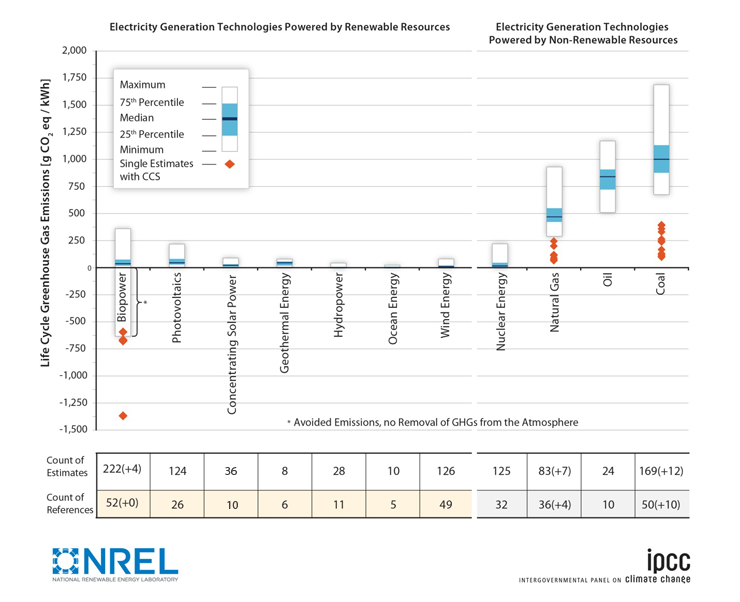
However, there are some other considerations to make in terms of sustainability. First, large hydroelectric facilities are not very environmentally friendly. Depending on the location, there can be problems with flooding of habitats and even towns, compromising fish migration, altering stream content and temperature, impacting scenic areas, and other considerations. The articles below provide some insight into some of these potential problems. Note also that not all hydro has the same problems - by using different types of hydroelectric facilities such as run-of-river and micro-hydro [12], environmental and social impacts can be minimized.
Optional Reading
- "Hydropower Explained: Hydropower and the Environment [13]." U.S. EIA.
- "China Admits Problems with Three Gorges Dam [14]." Michael Wines, New York Times.
- "Run-of-river hydro, Indonesia [15]." (Video).
- "Solar Power Explained: Solar Energy and the Environment [16]." U.S. EIA.
- "Environmental Impacts of Wind Power [17]." Union of Concerned Scientists.
In terms of social equity, there are a few important considerations to make. First of all, do people have access to energy, and can they afford it? This is a tricky question to answer, as it depends on a lot of factors, many of which were indicated above. Some equity and other considerations include:
- Solar panels used to be prohibitively expensive, but new business models are making them much more affordable, even effectively free to the customer.
- Wind and hydro can usually be purchased through utilities at the same or lower rates than fossil fuels.
- One very important equity consideration is that fossil fuel power plants are often sited near low-income areas of the country and world, and thus the negative health impacts are unevenly distributed, with the least powerful bearing the brunt. (The term "environmental justice" hopefully comes to mind for you right about now!) Add to the previous point that the environmental destruction from coal mining is especially unevenly distributed.
- Wind turbines can be a nuisance, as indicated in the article above, but is relatively minor compared to power plants.
- Solar is usually unobtrusive, though some people do not like "the look" of the panels.
- Large hydro can have a major social cost, as you may have seen in the article above. Flooding of houses and even whole towns can result from dams being built, though this is more the exception than the rule in industrialized countries. As always, these impacts are disproportionately felt by low income and marginalized people.
One of the benefits of conventional energy generation is that the infrastructure is largely set up, at least in industrialized countries. In the U.S., for over 100 years, we have built an energy infrastructure based on large power plants and fossil-fuel based vehicles. This gives conventional energy sources an advantage in terms of providing access. That said, wind, hydro, and solar can all utilize the existing infrastructure. Hydroelectric dams provide the same service as fossil-fuel power plants, but usually on a slightly smaller scale, so they are a good fit. They also provide a very consistent stream of electricity as long as no droughts are occurring, and they can increase and decrease production pretty rapidly, unlike solar and wind.
Probably the biggest current problem with solar and wind is that they are intermittent - the sun does not always shine, and the wind does not always blow. This is a major issue because we currently do not have the storage capabilities to provide the energy on command. One common problem with wind and solar are that they are often highest in areas with low population densities. In the U.S., for example, the greatest on-shore wind resources are in the Great Plains in the Midwest, where the population density is very low.
 [18]
[18]
One of the benefits of solar is that as long as there is not too much shading, many households can satisfy their energy needs using existing rooftop spaces. However, not every location is ideal for solar. The intermittency of wind and solar is also a major problem, as noted above. This will change if/as battery technology becomes more accessible, and as the grid is upgraded.
Summary
Overall, the biggest advantages of renewable energy sources are:
- they are inexhaustible (hydro has limits though), carbon-free, and have very minimal environmental impacts (notwithstanding large hydro);
- they also tend to be more democratic, in that many of them are suitable for scaling down to a personal level. This is not possible with current technology for fossil fuel-based electricity generation;
- most of them are also cheaper than almost all forms of non-renewable energy, as long as they are properly sited.
The main disadvantages of solar, wind, and hydro are:
- they are intermittent, and so without storage cannot be relied upon to deliver energy when needed;
- they are not able to be deployed in every location, e.g.; shaded areas for solar, calm areas for wind, and dry areas for hydro;
- large-scale hydro has a lot of negative environmental impacts, and there are some environmental and social problems with wind.
The last thing I'd like to note is that the most sustainable energy is the energy that you don't use. Remember that energy efficiency is sometimes called the "fifth fuel?" That is very much applicable to these considerations. Also, as noted above, energy efficiency has been found to have a lower LCOE than any other energy source! [20] The more we can reduce our energy use while getting the same benefits from the energy service, the better off we will be.