Lesson 8: Waste Management
Overview
The focus of this lesson is on ways to sustainably manage natural resources.
Learning Outcomes
By the end of this lesson, you should be able to:
- define natural resources;
- describe why the term "natural resources" is anthropocentric;
- analyze the difference between linear and circular resource flows;
- describe the differences between reduction, reuse, and recycling; and
- identify components of the circular economy and cradle to cradle certification.
Lesson Roadmap
| To Read | Lesson 8 Online Content | You're here! |
|---|---|---|
| To Do |
|
|
Questions?
If you have any general course questions, please post them to our HAVE A QUESTION discussion forum located under the Discussions tab in Canvas. I will check that discussion forum regularly to respond as appropriate. While you are there, feel free to post your own responses and comments if you are able to help out a classmate. If you have a question but would like to remain anonymous to the other students, email me through Canvas.
If you have something related to the material that you'd like to share, feel free to post to the Coffee Shop forum, also under the Discussions tab in Canvas.
Natural Resource Use
I'm sure you've heard the term "natural resources" used many times, e.g., when someone talks about "preserving natural resources" or when you hear about "natural resource management." It's a pretty innocuous term, and seemingly straightforward. If you asked someone what natural resources are, they would probably say something about "resources provided by nature, such as trees, minerals, and food" or something to that effect. (This is actually a pretty good definition, by the way!) When thinking about the definition, it's easy to focus on the "nature" component and look past the "resources" part. Specifically, it is important to note that "natural resources" is an anthropocentric (human-centered or focused) term. It is a concept that only exists because of humans because it refers to things that impact humans. To demonstrate this, let's look at a few definitions of natural resources:
things such as minerals, forests, coal, etc. that exist in a place and can be used by people
~Cambridge Dictionary [1]
industrial materials and capacities (such as mineral deposits and waterpoer) supplied by nature
~Merriam-Webster [2]
a naturally occurring source of wealth, as land or water; the natural wealth of a country, consisting of land, forests, mineral deposits, water, etc.
~dictionary.com [3]
Any way you slice it, without humans natural resources don't exist, they would just "be" or just be "nature." This is important to keep in mind as we go over this lesson: by definition, natural resources only exist as a concept because they can be used by humans.
Hidden Resource Use
Personal consumption expenditures (household spending on goods and services) constitutes nearly 70% of U.S. GDP [4]. Much of this is on services, but Americans now spend nearly 4.5 trillion dollars on "goods," which includes everything from food, to energy, to cars, houses, clothing, and other goods. See the charts below from the Federal Reserve Bank of St. Louis [5] for these consumption trends over the past 60+ years. They are an excellent, reliable resource for economic data. (For a good explanation of goods and services, see this explanation [6]from thebalance.com.)
The moral of the story: Americans buy a lot of stuff! This has many implications, but one is particularly important with respect to this lesson. Namely, almost all of this spending requires the use of natural resources. Obviously, things like cars and clothes require raw natural resources to produce, though you may be surprised at how many. Take a look at the infographic below from Allianz to get some idea of how many different natural resources from all over the world are needed to make a car.
 [8]
[8]
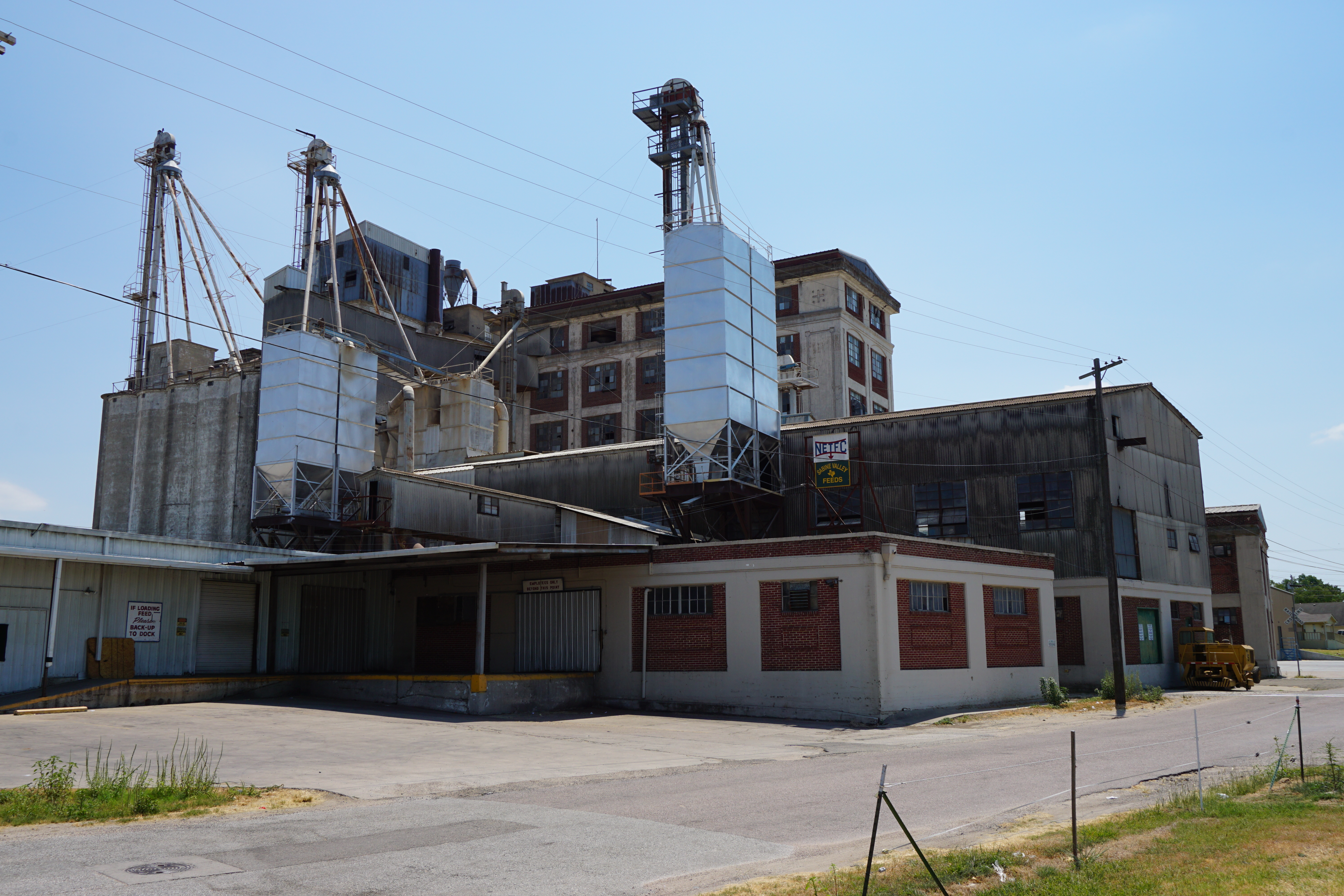
All goods require some mixture of raw natural resource extraction, manufacturing, processing, shipping, packaging, use, and disposal. All of this requires energy and resources. Most of this use, as indicated in the infographic above, is hidden. I will give you one more quick example: I used to assist with industrial energy audits on a part-time basis while in college. One of the places we audited was a "feed mill," which is essentially a factory that produces chicken feed. (Related note: Delaware is considered the poultry capital of the U.S.) The facility looked a lot like the one in the image below.
.jpg)
I was dumbfounded at how much energy and resources went into just producing feed for chickens! While I was there, there was a constant arrival of tractor trailers hauling raw ingredients - corn, soybean, nutrient mixes, and other things - and the machinery was massive and energy-intensive. According to Delmarva Poulty Industry, Inc. [12] (Delmarva includes parts of Delaware and the eastern shores of Virginia and Maryland), the Delmarva chicken industry had the following specifics in 2017:
- 605 million chickens (4.2 billion pounds) produced
- They purchased "87 million bushels of corn, 36 million bushels of soybeans, 1.6 million bushels of wheat," all for chicken feed. Imagine all of the water, fertilizer, and energy that went into the production of these crops.
- They "purchased $240 million in packaging and processing supplies."
The point here is not to go in-depth into the poultry or automobile industries, but to indicate that nearly everything you purchase is the product of a tremendous use of resources, much of which is hidden. But services such as healthcare and education also require the use of resources. Medical facilities need chairs, tables, x-ray machines, paper, and so forth, and use a lot of energy. Even an online class requires physical resources, in particular, electricity and all of the lifecycle resources used to generate that energy (mines, power plants, power lines, equipment to manage it all, etc.), but also the device you are viewing this on is the result of a global supply chain of goods. This type of lifecycle resource use and our consumption-driven economy are major contributors to the fact that we would need nearly 5 planet earths to satisfy humanity's needs if everyone lived like the average American.
Resource Flows
Linear Resource Flow
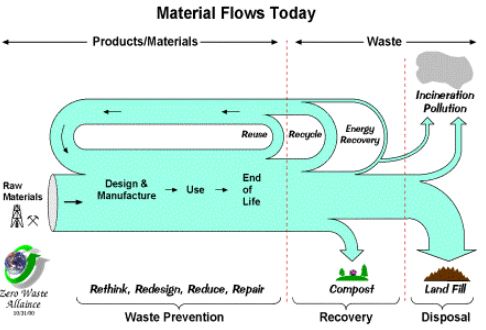
The problems associated with the massive amount of resources used to produce everyday goods and services is compounded by the fact that this system is based mostly on linear resource use. This is often referred to as "take, make, waste." An illustration of the basic resource flow is shown below.
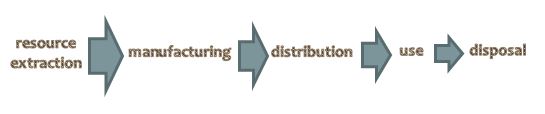
This linear model typically goes something like the following:
- Natural resources are extracted through mining, growing, gathering, etc. They are often shipped all over the world, e.g., as indicated in the automobile infographic above.
- These raw resources are then manufactured into final goods, both perishable and non-perishable. This almost always occurs on an industrial scale (think of the massive factory farms, manufacturing plants, and even the feed mill illustrated above).
- These goods are then distributed, usually globally. Take a look at the label on your clothes (Bangladesh and Vietnam are common), electronics (China, most often), and food (could be anywhere - Chile, Mexico, New Zealand, etc.).
- They are then used by the end user.
- Most of the time, they are then disposed of in a landfill.
- Note that all along the way there are waste and emissions being generated, most of which are emitted or landfilled.
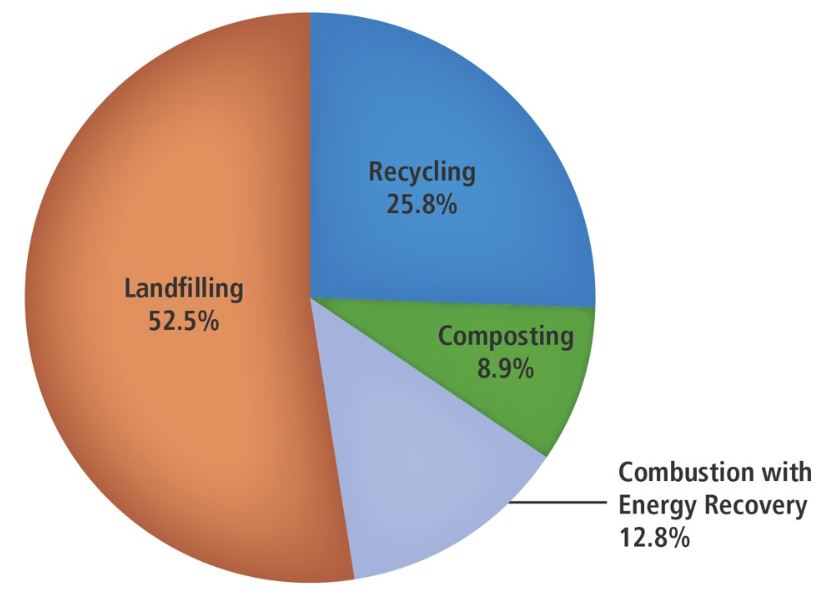
This model requires the constant input of raw natural resources because of the waste and emissions along the way, and because most of the "waste" is dumped in a landfill (and possibly incinerated), and all of this is done primarily with the use of non-renewable energy. This is a major reason why our ecological footprint is so large and we are using natural resources at such a high rate. Globally, only about 14% [14] of the primary energy used is renewable. In the U.S., over half of municipal solid waste (MSW) ends up in a landfill. Keep in mind that municipal solid waste is basically household garbage, and does not include construction, industrial, or farming waste, which make up a large portion of the waste stream. All of this adds up to 262.4 million short tons of MSW generated (about 4.5 pounds per person per day), of which about 138 million tons ends up in a landfill, according to the U.S. EPA [15].
Circular Resource Flow
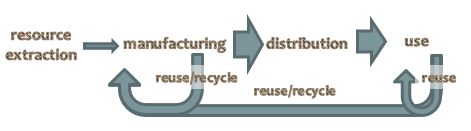
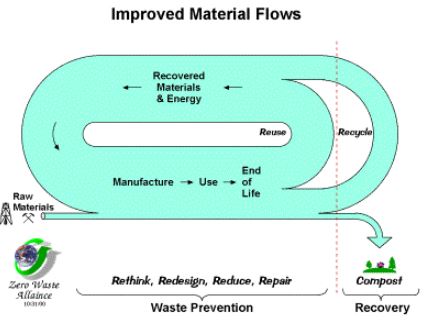
Contrast this with a circular resource flow model, in which there is almost no waste. Any resources that are unused in each step are reintegrated back into the system. Manufacturing "waste" is reused or recycled, as are final products used by the end user. If this could all be run using renewable resources, then much of the pollution would be eliminated as well. In fact, in an ideal circular resource system, the idea of "waste" does not exist. This is the philosophy behind "zero waste" initiatives. Note that because of thermodynamics, there will be some inefficiency, and thus some loss. This is why there will still be some natural resource input required.
It is worth noting that nature utilizes circular resource flow. Recall that it was stated above that the concept of natural resources is anthropocentric. There is no waste in nature - everything is a resource for some other process. Resources move around in continuous flows, and all "waste" is reintegrated back into the system, with the exception of some heat loss that is radiated back to space. All of this is of course driven by renewable energy, and any energy lost to space is offset by energy coming in from the sun. This is why many zero waste (and other sustainability) advocates say that the more we can design human systems to mimic natural systems, the more sustainable those systems will be. As you will see in a future lesson, this is the fundamental philosophy of permaculture.
The Zero Waste Alliance provides an excellent visualization of what such a system could look like. The images below show natural resource flows. The thickness of the flows indicates the relative amount of resources flowing through that part of the system. As you can see, by recovering most of the "waste" throughout, the raw materials flow (at the far left of each diagram) is greatly reduced. Note that the second image shows an idealized flow - there will be some loss due to thermodynamics. Even without thermodynamic loss, some natural resource extraction is required because some resources cannot be directly reused in the manufacturing process.
Waste Management Strategies
The Three Rs
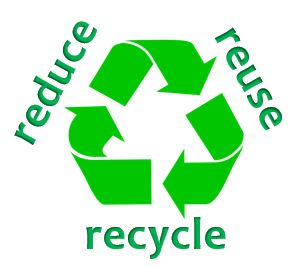
No doubt you have seen some variation of the image below. Most recyclable packaging has a triangle design, which indicates that it is recyclable. You are probably familiar with the phrase "reduce, reuse, recycle," which is hammered home to (most) kids at a very early age in the U.S. The image clearly gives a nod to circular resource use (follow the arrows!). Each term refers to a slightly different way to manage waste. I provide an example of each in parentheses as it relates to a plastic water bottle:
- "Reduce" refers to not creating the item/material in the first place. (Don't buy or use the plastic bottle in the first place.)
- "Reuse" refers to reusing the item (or at least part of the item) for another purpose. (Examples include refilling it with water and using it again, using the plastic bottle to start a seedling or make a small bird feeder. If you make a new, useful product out of it - such as the bird feeder - it is sometimes considered "upcycling.")
- "Recycle" refers to breaking the item down into smaller components and using these materials as a replacement for materials in newly manufactured goods. (A plastic bottle can be recycled and made into a different plastic product.)
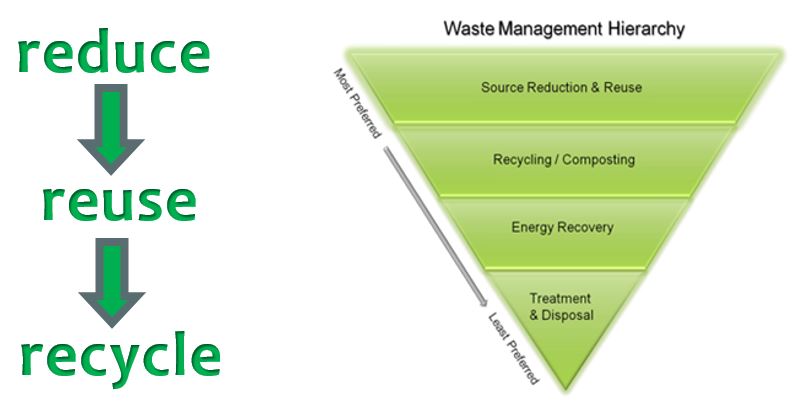
However, what most people do not know is that "reduce, reuse, recycle" is actually a priority list. In other words, the best way to minimize the impact of waste is to not use it in the first place (reduce), the second best way is to reuse it, and the third best way is to recycle it. Recycling requires a lot of inputs: inefficient trucks to pick it up and transport it, massive machinery to sort it and break it down, more machinery to produce the new good (often after shipping the raw resource far away), then more energy and resources to distribute the good. This entire process uses energy and generates waste. Reuse is less impactful because it cuts out all of the downstream impacts of recycling, but it does not eliminate all of the upstream impacts that resulted from producing the good in the first place.
While all of this is true, recycling is still much more beneficial than landfilling! The following are some statistics from the EPA [18]. All information was taken from WARM, the Waste Reduction Model. (Click here to download the Excel file [19] and do your own analysis, or just explore the data.) Note that MMBTU is one million BTUs of energy, and MTCO2e refers to one megaton of carbon dioxide equivalent:
| material | reduction energy savings (MMBTU/ton) | recycling energy savings (MMBTU/ton) | combustion energy savings (MMBTU/ton) | reduction emissions savings (MTCO2e/ton) | recycling emissions savings (MTCO2e/ton) | combustion emissions savings (MTCO2e/ton) |
|---|---|---|---|---|---|---|
| aluminum cans | 89.69 | 152.76 | -0.60 | 4.91 | 9.11 | -0.04 |
| glass | 6.9 | 2.13 | -0.50 | 0.53 | 0.28 | -0.03 |
| PET plastic | 50.26 | 31.87 | 10.13 | 2.20 | 1.12 | -1.21 |
| corrugated cardboard | 33.23 | 0.69 | 6.64 | 5.60 | 3.12 | 0.51 |
| newspaper | 36.46 | 16.49 | 7.53 | 4.77 | 2.75 | 0.58 |
Notice that with the exception of aluminum cans, the energy and emissions reductions are always greater when you reduce than when you recycle. Based on what I could see in the WARM spreadsheet, aluminum cans are the only material for which recycling is more impactful. Also note that some materials require more energy to burn than they do to landfill (see the negative numbers), and for ALL materials listed, combustion is worse for emissions than recycling or reducing.
The Circular Economy
The circular economy, as you will see below, utilizes circular resource use.
Living systems have been around for a few billion years and will be around for many more. In the living world there's no landfill; instead, materials flow. One species' waste is another's food. Energy is provided by the sun. Things grow, then die, and nutrients return to the soil safely. And it works. Yet as humans we've adopted a linear approach. We take, we make, and we dispose. A new phone comes out, so we ditch the old one. Our washing machine packs up, so we buy another. Each time we do this, we're eating into a finite supply of resources and often producing toxic waste. It simply can't work long-term. So what can? If we accept that the living world's cyclical model works, can we change our way of thinking so that we too operate a circular economy?
Let's start with the biological cycle: How can our waste build capital rather than reduce it? By rethinking and redesigning products and components and the packaging they come in, we can create safe and compostable materials that help grow more stuff. As they say in the movies, no resources have been lost in the making of this material.
So what about the washing machines, mobile phones, and fridges? We know they don't biodegrade. Here we're talking about another sort of rethink. A way to cycle valuable metals, polymers, and alloys so they maintain their quality and continue to be useful beyond the shelf life of individual products. What if the goods of today became the resources of tomorrow? It makes commercial sense. Instead of the throwaway and replace culture we’ve become used to, we'd adopt a return and renew one where products and components are designed to be disassembled and regenerated.
One solution may be to rethink the way we view ownership. What if we never actually owned our technologies? We simply licensed them from the manufacturers.
Now let's put these two cycles together. Imagine if we could design products to come back to their makers, their technical materials being reused and their biological parts increasing agricultural value? And imagine that these products are made and transported using renewable energy? Here we have a model that builds prosperity long-term. And the good news is there are already companies out there who are beginning to adopt this way of working. But the circular economy isn't about one manufacturer changing one product. It's about all the interconnecting companies that form our infrastructure and economy coming together. It's about energy. It's about a rethinking of the operating system itself. We have a fantastic opportunity to open new perspectives and new horizons. Instead of remaining trapped in the frustrations of the present, with creativity and innovation, we really can rethink and redesign our future.
Here’s an idea. What if you never had to buy a light bulb again? Instead, you lease light, like you lease a car or an apartment. It's just one idea that’s part of the circular economy. Before we can understand the circular economy, well, it helps to define the linear economy. Most organizations today operate in the linear economy which is based on a 'take, make, and dispose' model. So, for example, a light bulb company takes resources, like glass or metal, to manufacture its products. The company makes the bulb and sells it to a customer like me who uses it. Once the light bulb burns out, I dispose of it. It’s likely neither the company nor I will ever see that light bulb again. For a light bulb company to make money in the linear economy, it tries to buy materials for the lowest cost possible and to sell as many bulbs as possible. This model operates as if there are infinite resources, like glass or metal, in the world. But you and I know that’s not the case. That’s why the circular economy treats materials like they're finite. A company in the circular economy doesn’t just recycle products but maintains ownership of them all along, so the model looks more like this: make, use and return.
Let’s go back to the light bulb example. Instead of buying bulbs, this office in London leases its light from Philips Lighting. It signed a 15-year lease for the service and pays a fee each quarter. Philips still owns the actual lightbulbs and provides maintenance and replacements when needed, no extra cost. This model gives Philips the incentive to produce energy-efficient light bulbs and it saves the office money with fixed lighting costs. It’s a radically different business model that makes companies more like service providers than sellers of a physical product.
And it turns out lots of companies are looking for ways to get involved. Take H&M, one of the world’s largest clothing retailers. It’s working on a strategy to become 100 percent circular. The company collects old garments in its stores and recycles them. Since 2013, H&M says it has gathered more than 55,000 tons of fabric to reuse for new garments. Some governments are getting on board with the circular economy, too. The European Union adopted an action plan in 2015 aiming to make supply chains, you guessed it, more circular. This includes everything from production to consumption, repair and manufacturing, and waste management.
The point isn’t just to become more 'green' and create environmental benefits, there could be economic benefits too. One report estimated a shift toward the circular economy in the E.U. could increase GDP by an additional 12 percentage points by 2050. But moving from the linear economy to the circular economy also brings costs. Companies would need to redesign their supply chains and products in order for them to be used again and again. Manufacturers might be burdened when it comes to the actual logistics of disposing and recycling. A recent report found only 22 percent of U.K. companies are trying to generate value from products that are returned for reuse, recycling or refurbishing. It’s estimated the cost of transitioning to a fully efficient reuse and recycling system across Europe could be as much as 108 billion euros, roughly 130 billion dollars. Cost is one thing. Changing people’s mindsets is another. And that’s what it'll take for the circular economy to go from an idea to reality for everyone.
Hey guys, it's Elizabeth, thanks so much for watching! You can check out more of our videos over here. We're also taking your suggestions for future CNBC Explains, so leave any ideas in the comments section. And while you're at it, subscribe to our channel. See you later!
There are a few ideas underlying the circular economy concept, as described in the videos:
- The current model is take, make, dispose of. (This should sound familiar!) As they indicate, nature does not operate this way - there is no "waste" in nature - and in order for society to be sustainable, we should follow the natural model.
- As CNBC notes in the video: "For a light bulb company to make money in the linear economy, it tries to buy materials for the lowest cost possible and to sell as many bulbs as possible. This model operates as if there are infinite resources, like glass or metal, in the world." They recognize that we cannot continue to use natural resources at an unsustainable rate. (Again, this should sound familiar.)
- People do not actually need to own things, they need/want the service provided by those things. Is the point of purchasing a light bulb to own the light bulb? For most people, no. They just need light. Do you really need a washing machine? Again, the answer is "no." You just need clean clothes. There are innumerable examples of this - cars, microwaves, cell phones, refrigerators, furnaces, even clothes.
- If ownership is retained by companies, then it is in their best interest to make the products last as long as possible by making long-lasting products that can be repaired. It is also often beneficial to them to be able to reuse components from products that are no longer in use.
- The first video (from the Ellen MacArthur Foundation), sums up the concept very nicely: "Now let's put these two cycles together. Imagine if we could design products to come back to their makers, their technical materials being reused and their biological parts increasing agricultural value? And imagine that these products are made and transported using renewable energy? Here we have a model that builds prosperity long-term."
The MacArthur Foundation notes that the circular economy is "about a rethinking of the operating system itself." This is a very important point! The take-make-dispose process is systemic, and is deeply ingrained in society. If we are to get past this mindset, systemic change is required.
Of course, we are socialized to believe that ownership is important (Americans in particular love buying stuff), so the establishment of a circular economy will require social change. This may seem a difficult hill to climb. Well, it is, actually, but allow me to provide one example of why it may be more feasible than you think. Consider the ubiquity of Uber and Lyft. It may be difficult to imagine, but try to think back 10 years ago, before ridesharing existed. Treating automobile transportation as a service was mainly reserved for taking cab rides in cities. Now you can take an Uber in over 60 countries [20] across the world, and the service is available even in rural areas of the U.S. The point here is not that Uber and Lyft are examples of the circular economy (though they do minimize the necessity of automobile production), but that personal transportation is increasingly being viewed as a service. It is a rather commonly held belief [21] that autonomous vehicles will reduce vehicle ownership. Rideshare and car companies are already testing driverless vehicles, and in the not-too-distant future, they will increasingly own their own vehicle fleet instead of paying others to drive, or in the case of car companies, expecting consumers to buy their cars. If/when that happens, it will be to their benefit to extend the use of their fleet as long as possible.
Cradle to Cradle Design
Please watch the video below for some insight into an application of the circular economy called Cradle to Cradle Design.
As you can see, cradle to cradle (C2C) concept is an application of the circular economy. The concept is summed up rather well in the video when they state that C2C is all about "keeping all materials in continuous cycles, stimulating the use of renewable energy only, and celebrating diversity," though there is more to it, as you will see below. The following are some of the key points from the video above:
- They characterize the concept of reduce, reuse, recycle as "less bad" and the goal of C2C as "100% good." They acknowledge that the 3 Rs are better than the linear resource use model, but that they will not solve our long term resource and waste problems because there is still some waste, and because the global population is still growing. If C2C were fully implemented, the entire system of design and manufacturing of goods would be reconfigured. In other words, it requires systemic change.
- I remember watching a TED Talk by one of the creators of the C2C concept, William McDonough, and he characterized the 3 Rs as "an efficient pursuit of the wrong goals." In other words, doing things like recycling plastic bottles is better than just throwing them away, but a properly designed container would be designed with the intent of fully reintegrating all of the materials back into the original process. As they state in the video: “The design is thought through on how to disassemble it and how the used materials are valuable to nature or as resources for the production of new products.”
- They note that one of the primary tenets of C2C is "waste = food." They think that the concept of "waste" should not exist. They describe two cycles that should be utilized when products are no longer used: Organic materials should be returned to the biological cycle (compostable packing, etc.) and non-organic materials (metals, etc.) should be reintegrated into the technical cycle. They often refer to these non-organic components as technical nutrients. Just as biological nutrients are used by natural processes, technical nutrients should be reused in technical processes.
The Cradle to Cradle Products Innovation Institute [22] has taken this concept beyond the conceptual phase and created a process to certify products using their Cradle to Cradle CertifiedTM product standard [23]. The standard is described as follows:
The Cradle to Cradle Certified [24]™ Product Standard [24] guides designers and manufacturers through a continual improvement process that looks at a product through five quality categories — material health, material reutilization, renewable energy and carbon management, water stewardship, and social fairness. A product receives an achievement level in each category — Basic, Bronze, Silver, Gold, or Platinum — with the lowest achievement level representing the product’s overall mark.
Product assessments are performed by a qualified independent organization trained by the Institute [25]. Assessment Summary Reports are reviewed by the Institute, which certifies products meeting the Standard requirements, and licenses the use of the Cradle to Cradle Certified™ word and design marks to the product manufacturer. Every two years, manufacturers must demonstrate good faith efforts to improve their products in order to have their products recertified.
The five quality categories [26] are as follows:
Material Health: Knowing the chemical ingredients of every material in a product, and optimizing towards safer materials.
Material Reutilization: Designing products made with materials that come from and can safely return to nature or industry.
Renewable Energy & Carbon Management: Envisioning a future in which all manufacturing is powered by 100% clean renewable energy.
Water Stewardship: Manage clean water as a precious resource and an essential human right.
Social Fairness: Design operations to honor all people and natural systems affected by the creation, use, disposal or reuse of a product.
If a product would like to go for C2C certification, it is evaluated based on these five categories. It receives a score in each category - basic, bronze, silver, gold, or platinum. These are also the five levels of cradle to cradle certification. The certification level is based on the lowest score that the product receives in these categories. For example, if a product earns a "gold" score in material health, material reutilization, renewable energy & carbon management, and water stewardship, but only earns a "basic" score in social fairness, then the product is certified as "basic." Another important aspect to point out is that all products must be recertified every two years, and in that time, must demonstrate good faith efforts to improve the products.
More Site Visits!
Here are some more site visits! Again, this is not required reading. I suggest browsing through them if/when you have time. This may help inspire your final project proposals!
- Ecocycle [27], Boulder
- Great Divide Brewery [28], Denver
- Desert Weyr [29], Paonia
- The Growhaus [30], Denver
Summary and Final Tasks
Summary
By now, you should be able to do all of the following:
- define natural resources;
- describe why the term "natural resources" is anthropocentric;
- analyze the difference between linear and circular resource flows;
- describe the differences between reduction, reuse, and recycling; and
- identify components of the circular economy and cradle to cradle certification.
Reminder - Complete all of the Lesson 8 tasks!
You have reached the end of Lesson 8! Double-check the to-do list on the Lesson 8 Overview page [31] to make sure you have completed all of the activities listed there before you begin Lesson 9.