An Introduction to the Energy and Sustainability Policy Program
Lesson 1 Overview
Program and Course Overview
Welcome to EMSC 302! This is just the beginning of the Energy and Sustainability Policy program, and it might be a brand-new beginning (or one after an extended break from school) for you. We want to make sure that you have all of the resources you need to be successful in your educational endeavor. This orientation course will familiarize you with the people, resources, materials, and tools that will help you as you progress through the program.
About This Lesson
The first lesson is an introduction to the program's people. We'll also review the course structure and technical requirements.
What will we learn?
By the end of this Lesson, you should be able to:
- identify key individuals in the ESP program;
- understand the way in which this course is structured and the technical requirements;
What will be due?
Refer to the Activities page for more information on the assessments for this lesson.
Questions?
If you have any questions, please post to "HAVE A QUESTIONS? Ask it here!" discussion forum (found in the "Helpful Resources" module) or e-mail the instructor (if the question is personal in nature).
Key Individuals
Key Individuals
Be sure to watch all of the videos below; you'll be quizzed on their content in Quiz 2!
There are many faces to ESP, but there are a few core instructors and advisers that you'll get to know during your time as an ESP student.
Mark Fedkin (2:28)
Hello, my name is Mark Fedkin, I am the Program Lead for the Energy and Sustainability Policy and it is my pleasure to welcome you to the Program.
The ESP is one of the few online programs in the country that examines the whole entire spectrum of energy options available to use with a specific emphasis on policy.
I came to the program from the Energy Engineering field. I earned my Ph.D. in Energy and Geo-Environmental Engineering from Penn State in 2003. Then I worked over about 15 years for the Penn State’s Energy Institute doing research and developing some new technologies for energy conversion and storage. One of my favorite areas of study was fuel cells. Those devices that are capable of converting chemicals such as hydrogen, methane, and even coal to electricity without burning them. So they may potentially have huge benefits to the environment. I was also involved in some projects on carbon sequestration and storage. We tried to find out what happens to carbon dioxide when it is put deep underground for storage in geological formations.
I have been at Penn State for about 20 years and really I like it here.
My family leaves in State College; I have three children - one in Elementary School, one in College, and one in Graduate School. So we all kind of separated now. I really like going on family trips that bring us all together. I also like to spend my free time in nature – running, hiking, or just walking around taking pictures. I really love art, especially photography, so I would visit modern art museums when I have a chance.
Once again, welcome and I hope you will enjoy the Program.
Matt Howard (2:42)
Hi, my name is Matt Howard. I'm your instructor for EG Ee41, Energy and a Changing World. In this course, we're going to cover the basics of energy provision in the US. We'll touch on some of energy's aspects and how it relates on global market places. But ultimately where we're going with this, whether we're talking about energy use in the US or globally, is how do we move from a fossil fuel based economy to one that's cleaner and relies more on renewable energy and more sustainable sources of energy to power our economies? Just in terms of my background, I've been in the sustainability field for almost 20 years. My academic background is actually in international economics. In a Bachelor's in International Econ. But I really started out my career pretty early on switching over into sustainability related work with the US Department of Commerce. That's really where I started my career in Washington DC, working for the federal government, primarily at the US Department of Commerce, where I helped develop sustainable manufacturing initiatives and other programs to help manufacturers be more resource and energy efficient. I jumped from commerce in from Washington DC and ended up taking a job with the mayor of the city of Milwaukee. And continued my sustainability career there as the Chief Sustainability Officer for the City of Milwaukee. And it's really there where I got a lot more deeply involved in energy issues, helping the city manage its energy portfolio, both in terms of how that was applied to buildings, but also facilities and street lights and all that good stuff. These days, I've been with a nonprofit organization called the Water Council. That's where I currently serve as vice president of Water Stewardship. We work with companies of all shapes and sizes all over the US and globally on water related issues in terms of how they use and impact water resources, but also there's that direct connection between water and energy. We do spend a lot of time talking about the nexus between water and energy and how that impacts manufacturing and our economy. Just in terms of me personally. I currently live in Milwaukee, Wisconsin with my family, my wife, and two kids. And we generally spend as much time as we possibly can outdoors, whether that's camping or hiking. I like to fly fish. When I'm inside, I like to listen to music. I'm a big sports fan that really leads me to my two truths and one lie. This relates to sports. Two truths, one lie, no particular order. I've attended the Indianapolis 500, I've attended a World Series baseball game, and I've attended a men's Final four basketball championship game. You can figure those out. I look forward to seeing you in EGEE 401. Thanks.
Daniel Kasper (2:08)
My name is Dan Kasper, and I teach EME 444 – Global Energy Enterprise, EM SC 240N – Energy and Sustainability in Contemporary Culture (which I also developed), and EM SC 470 – Applied Sustainability in Contemporary Culture (which I also developed).
I have a BS in Earth Science from Penn State, an MA in Geography University of Denver, and am working on a Ph.D. in Energy and Environmental Policy from University of Delaware.
I have worked in low-income energy efficiency training and advocacy and done some consulting in the energy auditing and solar fields. I teach in the Energy Technologies Department at Delaware Technical Community College, where I focus on energy efficiency and sustainability. I’m also the International Education Coordinator at Delaware Tech. I’ve taken students to Italy, Denmark, and Switzerland, and am taking PSU students to Colorado this summer.
I am a firm believer in getting out of your comfort zone, and believe that life should be made as interesting as possible by engaging in small and large adventures, whether it’s figuring out how to cook a new dish or take something apart, talking to random people, listening to new music, or getting lost in a different country.
I worry a lot about the sustainability of our future and spend a lot of time thinking about how we can advocate for sustainability-focused policies at all levels of government, and advocating for sustainable lifestyles in general.
Two truths and a lie:
- I have a cat that was in a coma at one point in his life, only to miraculously survive. The nurses made up a song for him, “JoJo was a cat, we thought he was a goner, but now he’s just a friend of mine…” (to the tune of “Get Back” by the Beatles)
- Coffee generally has the reverse effect on me that it has on most other people – it actually helps me fall asleep at night. This is something that runs in my family.
- I am missing one major organ.
- Thanks for reading, and good luck!
Edwin Pinero (1:53)
Hi, my name is Ed Pinero, and I will be the instructor for EGEE 401, Energy in Changing World. I am new to the Penn State World Campus family, and I look forward to working with all of you.
I live in Lancaster County here in Pennsylvania, although am originally from New York City, with stints in various other states. I am a geologist and earth scientist by Education, but my background is in a wide variety of topics in the areas of sustainability and environmental science. This ranges from my early days as an oil and gas exploration and production geologist, to various times as a consultant to the private and public sector on many aspects of sustainability and environment.
In the realm of energy- I have had many diverse roles dealing with energy best practices, the business case for energy management, and policy development. I was the State Energy Director for Pennsylvania, as well as being the Federal Sustainability Officer, which included overseeing various energy-related activities throughout all Federal agencies and facilities.
From other personal interests’ perspective, I am very interested in astronomy, and since 2001, I have served as a NASA Solar System Ambassador, helping promote awareness and understanding of NASA's planetary exploration program.
I am to offer you two truths and a lie and see if you could pick out the lie. So here we go! First, as part of the various roles in my career, I do a lot of international travel. I was at a standards development meeting in Australia some years ago and the event dinner main entree was kangaroo! Second, I am an avid Star Wars and Star Trek, and can recite much dialogue from the movies. And thirdly, part of my job as State Energy Director was to help set pricing for various fuels sold in the state.
Brandi Robinson (2:21)
Hi everyone, welcome to the ESP Program! I’m Brandi Robinson. I teach GEOG 432, a class about energy and climate policy. I also teach GEOG 438W – a writing intensive course about the human dimensions of climate change and I teach EME 466, the capstone course. So, I’ll see you at the other end of your journey! I’ve been with the ESP program for a little over 8 years now. Prior to that I worked for Environmental Credit, a greenhouse gas offset project developer, where I was a policy analyst and account manager helping dairy and hog farmers manage methane emissions from their manure (glamorous, I know). Now, I work in my own township as the chair of our climate action committee to inventory our emissions and begin working toward our ambitious net zero by 2050 goal. Outside of work I’m a mom and enjoy traveling, baking, and crafting as well as hunting for vintage pyrex at thrift stores. Two truths and a lie! (1) I grew up on a dairy farm near Williamsport, PA. (2) My daughter is fluent in a foreign language I don’t speak. (3) I was never on an airplane until I was 22. Looking forward to working with you all!
Haley Sankey (1:22)
Hello, I am Haley Sankey and I am an Assistant Teaching Professor and an Adviser in the ESP Program. I also serve as the Program Coordinator. I teach EMSC 302, the ESP Orientation course, as well as EGEE 299 and 495, which are the Study Abroad and Internship courses respectively. I have been with Penn State for about 10 years now, but before that I worked for a consulting firm, helping utilities apply for relicensing from the Federal Energy Regulatory Commission, otherwise known as FERC. I’ve also worked with municipalities to reduce their energy use and watershed groups to clean up their waterways. I love to eat, cook, do any kind of outdoor activities, and really love to travel. My husband and I recently bought an RV so we can travel the US and visiting as many National Parks as possible! My two truths and a lie are that I hate winter and can’t stand being cold, I volunteer as ski patrol at our local ski mountain in the winters, and I studied abroad my senior year in Kerala, India. I look forward to working with all of you in the ESP program and good luck!
Jennifer Clemons (2:03)
World Campus Student Portal
World Campus Student Portal
Guess what? There's a plethora of information available to you at your fingertips! There are several websites that can help you find what you need, when you need it!
The Penn State World Campus Student website [6] (introduced as the "The World Campus Portal" in the New Student Orientation) is your student information center. (See screenshot below).
There are several important links available to you on this page, but probably the most important is the "Contacts & Help" tab! You can find the contact info for Tech Support, the Registrar, Financial aid, Bursar and Career Services all in one place!

The "Enrollment and Registration" page, shown on the screenshot below, will provide links to how to find and schedule a course, and explains how to drop a course!

The "Course Work and Success" page, shown on the screenshot below, provides links to your adviser, how to find course materials and how to prepare for your courses.

The Learning Environment
The Learning Environment
This course and all of your ESP courses will be conducted entirely online. There are no set class meeting times, courses are mostly run asynchronously, meaning you can access the course at any time throughout the week vs attending a course at a specific time every week. Even though the courses are asynchronous, you will be required to complete weekly assignments for most courses.
Canvas [8]
Canvas is Penn State's learning management system (LMS). It is where you can consult course calendars, communicate with your instructors and fellow students, submit assignments, receive feedback from the instructor, take online quizzes and surveys, and check assignment scores and course grades.
Registered students in this course will have access to all course materials using Canvas. Canvas is your classroom. Because the course content is directly imported into Canvas for you, you don't have to leave Canvas to view the course content (unless there's a linklinks to external pages are provided.)
You should have learned about how to utilize Canvas when you completed the New Student Orientation, but we also discuss it in depth and include some tutorials in a later lesson.
Canvas Help for Students
In the Helpful Resources module you'll find a link to the Canvas Help desk. Use the 5 minute rule: if you can't figure it out in 5 minutes, contact the Help Desk!
Course Expectations and Requirements
Course Expectations
ESP courses typically outline all requirements in the course syllabus. If you have a question about the mechanics or administration of the course, CHECK THE SYLLABUS FIRST. Chances are, the information you need can be found there!
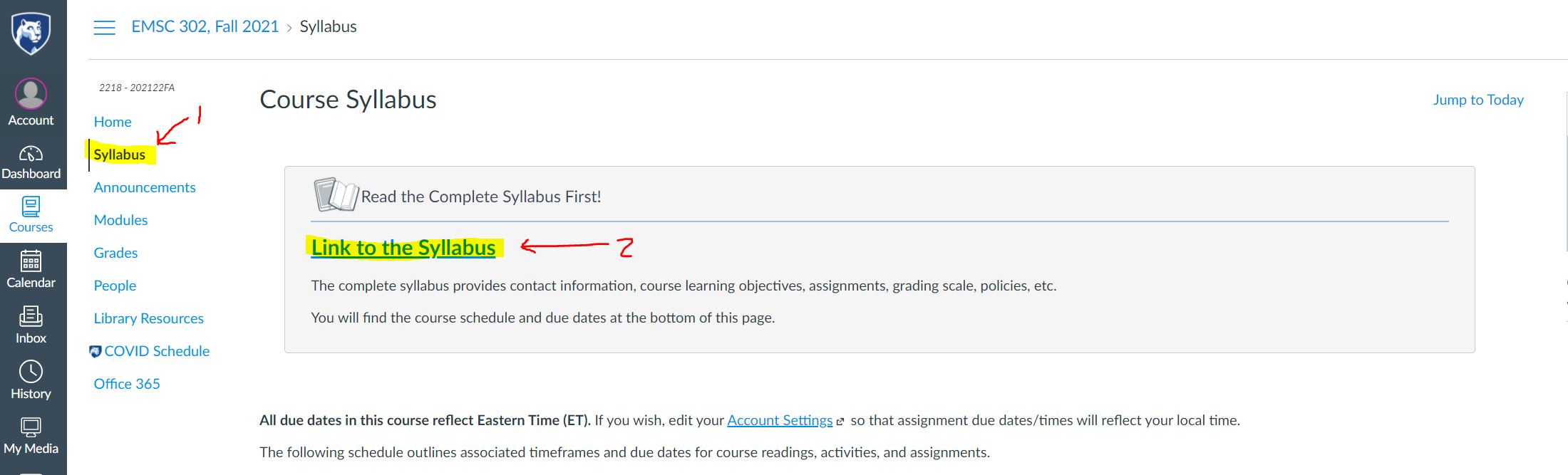
You can view the course syllabus by clicking on the "Syllabus" link in Canvas, on the left-hand side of your screen. See the screen capture below. If you do not see the Syllabus link in the left-hand menu, click on teh hamburger menu (the three lines) near the upper left corner of the Canvas page.
It is essential that you read the entire syllabus, It serves as the course "contract."
Technical Requirements
As we work through the course content, you need to make sure the computer you are using is configured properly for the lessons and assignments that you will encounter.
Note
Access to a reliable Internet connection is required for this course. A problem with your Internet access may not be used as an excuse for late, missing, or incomplete coursework. If you experience problems with your Internet connection while working on this course, it is your responsibility to find an alternative Internet access point, such as a public library or Wi-Fi® hotspot.
Software Requirements
In EMSC 302, students are expected to complete lesson assignments using Microsoft Office software, including Word and Excel. You can utilize Office 365 to access the Microsoft Office suite by logging on to the Penn State Office 365 Home Page [9].
Penn State Offers Office 365 Training [10] that will allow you to learn more about each tool.
Also, Google Drive (available to anyone) allows you to create/download/open Excel (.xls) and Word (.doc) files. Finally, your local library may be another option; many libraries offer the use of Microsoft Office programs at their public computer stations.
For this course, we recommend the minimum technical requirements outlined on the World Campus Technical Requirements [11] page. If you need technical assistance at any point during the course, please contact the World Campus HelpDesk [12].
Note
Links to any website outside of the course may not display if you are using the latest version of Firefox.
Much like a pop-up blocker because our courses use a secure URL and display the link inside of the content (e.g. when you are viewing TED or YouTube videos within a course page), Mozilla calls this "mixed content" and it may NOT display. The new browser's default is to block outside content. To unblock, users must click on the small shield displayed to the left of the URL and select, "Disable protection on this page."
If you have questions, please contact the World Campus HelpDesk [12].
Class Participation
Class Participation in a Virtual Classroom
For many of you, this Orientation Course is your first foray into the world of online classes, and you may find yourself asking, "What does participation have to do with anything?" The answer is - participation is important, not just for grades, but for enriching the experience you'll have in the ESP Program. You should also consider it a wonderful networking opportunity, to link up with classmates who have similar interests and career goals - and might be working for the types of employers you see yourself gravitating toward in the future! It's never too early to build bridges!
Please be sure to carefully read the Constructive Participation in ESP Peer-to-Peer Activities page [13] to better understand what is expected of you and your classmates. This information is also included in the course syllabus.
How is Class Participation Different in an Online Course?
Good question! Obviously, we're separated by time and space in an online course in a way with which residential courses don't have to contend. But, just like anything else, doing things differently (and being creative) doesn't mean doing things inadequately; some of the most engaging student discussions that happen have occurred in online courses, not residential ones - so get ready to chime in!
It is important that you not only check your Penn State email regularly (at least 4 times/week), but that you also log on to your classes regularly (multiple times/week) in order to actively participate in discussion forums, see updates on course assignments, etc. Many discussion forum rubrics will include a frequency component, meaning that one comment for the week may not meet the assignment expectations.
Most of your courses will be asynchronous.
This means that you aren't required to 'tune in' to listen to the instructor lecture at a certain time. Instead, the courses are designed so that working professionals like yourself can work through the material in your own time at your own pace. This means that your traditional group discussions will occur as a written format more than verbally talking to one another. Remember when Instant Messenger was popular? And you had to be online and not idle to chat with someone? Now we have Facebook and can post messages on people's walls or comment on their pictures and status updates when we see them, and they can respond whenever they see our posts. Online class discussions are similar to that same sort of communicating.
Written communication works better for some people than verbal communication.
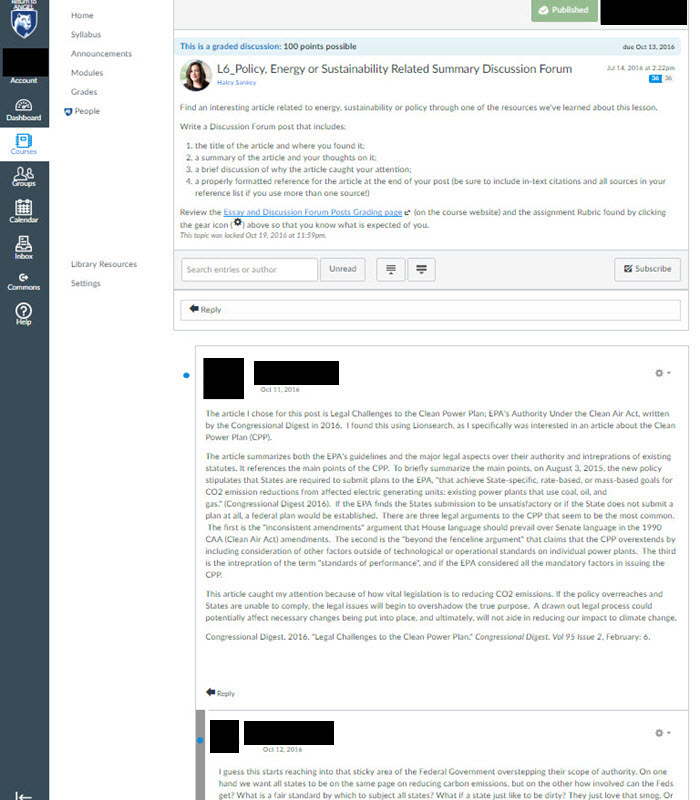
Maybe you were always the shy person in class who didn't want to raise your hand to answer a question or participate in a group discussion. Posting on discussion forums and commenting on other students' entries from a distance may provide you with a level of comfort. You might find that you're actually much more apt to chime into discussions online – that’s great! Or, maybe you're the person who was always first to speak up in class, and so you'll be the one to write your discussion forum posts or comments first and find yourself frustrated at waiting for classmates to respond. Either way, this can be an exciting new challenge as you embark on your education. You can see an example of what a discussion forum will look like at the bottom of the page.
The Internet is forever.
In some of the courses you'll take, you may be asked to post assignments to an approved blog space. Many of the topics you find yourself discussing may be controversial as they relate to climate, energy, and other environmental politics and policy. While we encourage you to be open and free with what you write, you should recognize that your postings will be out there for the world to see - so if you're going to make claims about (insert any controversial environmental topic here), you'll want to be certain to do it respectfully, grounded with facts with reputable sources, and in a way you would be proud for folks other than those in the class to see.
Input = Output.
Just like any other activity you’re involved in, you'll soon find that some people are more engaged in the material or the process than others. That's fine, but we want you to recognize that many of these courses are designed to force you to work together - across time zones and other hurdles. This isn't done to somehow make things more difficult for you - it's done to simulate the type of working environment you'll likely experience when you graduate. No one, especially those in sustainability issues of any kind, works in a solitary silo. It is in your best interest to make a genuine effort in the participation component of the courses you take in this program. It will enrich the experience you have in the course, likely improve your grade, and benefit your classmates as well.
Example of a Discussion Forum.
Activities
Lesson 1 Activities
| Requirement | Assignment Details |
|---|---|
| Quiz 1 |
Complete Quiz 1 Quiz 1 will test your knowledge of the information presented in the Syllabus and this lesson's Online Course Material. You will need to complete the quiz and earn >90% in order to access the rest of the Lessons for the course. |
| Quiz 2 |
Complete Quiz 2 Quiz 2 will test your knowledge of the ESP program faculty and staff. You will be asked to identify the lie that each person presented in their intro video. |
Summary
Lesson 1 Summary
In this lesson, we covered some overview information about the program and the course. Hopefully, you have a little better understanding of who is involved in ESP and how to navigate this course!
If you are feeling overwhelmed by the information presented in this lesson, contact the instructor immediately to set up a time to review the information together.
References
Lesson 1 References
Bransford, J. D. et al. (Eds.) (2000) How People Learn: Brain, Mind, and Experience. Washington, DC: National Research Council.
Chickering, A. W., and Gamson, Z. F. (1987) Seven Principles for Good Practice in Undergraduate Education. AAHE Bulletin, 39(7) 3-7.
Gibbs, G. (1999) Planning Your Students’ Learning Activities. In McKeachie, W.J. (Ed.) McKeachie’s Teaching Tips, 10th Ed. Pp. 20-33. Boston: Houghton Mifflin.
Palloff, R. M. and Pratt, K. (2001) Lessons from the Cyberspace Classroom: The Realities of Online Teaching. San Francisco: Jossey-Bass.
Swan, K. et al. (2000) Course Design Factors Influencing the Success of Online Learning. Proceedings, WebNet 2000 World Conference on the WWW and Internet. San Antonio, TX, October 30-November 4.