Sustainability Ethic
Sustainability Ethic
When YOU think of sustainability, you may think of recycling or waste management, or maybe even “the ability to continue a defined behavior indefinitely” (Thwink.org, 2014). However, as you will read in our textbook, Working Toward Sustainability, “there are at least 70 documented definitions of sustainable development or its sister term, sustainability” (2012). Definitions range from the simple: “living within limits” (sustainablemeasures.com), to the more focused: "improving the quality of human life while living within the carrying capacity of supporting eco-systems."
The term sustainability is fluid; its meaning can change based on context and who is doing the talking. So you can see why the term itself may be misunderstood or discussed abstractly at times. It is important that you have a general understanding of what sustainability is and what it means so that you can engage in discussions related to sustainability, no matter what the context. If you plan to build a career around sustainability, you need to be able to address it both in a broader scope and in varying contexts.
For the purposes of the ESP Program, we will use sustainability in the context of the Brundtland definition, which implies that sustainable development is “development which meets the needs of current generations without compromising the ability of future generations to meet their own needs.” This definition was born out of the United Nations World Commission on Environment and Development acknowledgment of the need to address poverty, environmental crises, and resource shortages. The balance of meeting the needs of our current and ever-growing population while also ensuring we don’t leave the earth in squalor for the next generation is difficult to define and implement.
The Bruntland Commission
When defining sustainability, we referred to a document from the United Nations called, Our Common Future [1] (1987). The initial commission of 1983 (the World Commission on Environment and Development) was later named the Bruntland Commission, after Chairperson Gro Harlem Brundtland of Norway. The commission and report were the first major international undertakings to look in depth at the systemic implications of human activity on the planet with respect to our relations with 1) contemporary global communities, 2) future generations of human society, and 3) the natural community, or environment, supporting life and biodiversity on Earth. In particular, the commission became cognizant that we as 'individuals' are tightly linked to all three communities.
Additional Resources
While there are many challenges associated with sustainable development, some broad areas tend to take the main stage; they can often be categorized as population, poverty, energy use, food, economy, environment and climate change. Each category can be further broken down into more specific focus areas. For example, the UN released the “17 Goals to Transform Our World [2]”. Go to their website and learn more about each goal by clicking on the associated tile shown.
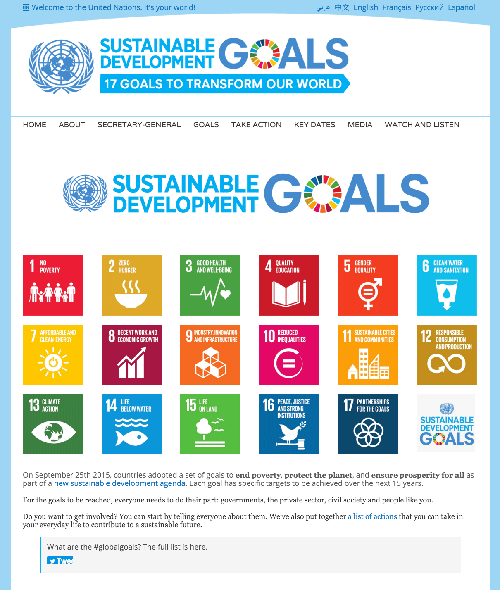
Now watch the following video produced by the U.N. about the 17 SDG's
Video: Do you know all 17 SDGs? (1:24)
The world’s best plan to end poverty
1: No Poverty
The world’s best plan to reduce inequalities
10: Reduced Inequalities
The world’s best plan to tackle climate change
13: Climate Action
The Sustainable Development Goals
17: Partnerships for the Goals
12: Responsible Consumption and Production
8: Decent Work and Economic Growth
3: Good Health and Well-being
14: Life below Water
6: Clean Water and Sanitation
13: Climate Action
15: Life on Land
16: Peace, Justice and Strong Institutions
7: Affordable and Clean Energy
5: Gender Equality
4: Quality Education
2: Zero Hunger
9: Industry, Innovation and Infrastructure
10: Reduced Inequalities
11: Sustainable Cities and Communities
1: No Poverty
Sustainable Development Goals
17 goals to transform our world
Learn more about the Sustainable Development Goals: un.org/sustainabledevelopment
Download the app sdgsinaction.com
Follow us @GlobalGoalsUN on Facebook and Twitter #GlobalGoals
Economic Dimensions of Sustainability Ethics
Economic Dimensions of Sustainability Ethics
You’ve all heard the term “triple bottom line” (TBL), but what does it mean? It's a way of measuring success beyond profits alone.
“The TBL is an accounting framework that incorporates three dimensions of performance: social, environmental and financial. This differs from traditional reporting frameworks as it includes ecological (or environmental) and social measures that can be difficult to assign appropriate means of measurement. The TBL dimensions are also commonly called the three Ps: people, planet and profits.”
Are you starting to get the drift of the depth and breadth of the interconnectedness theme that keeps appearing in our readings and discussions?
The idea that businesses should measure more than just profit didn’t come to fruition until the mid 1990s. Since then, there's been a concerted effort to define the parameters involved in the TBL and how to measure those parameters. Because measuring sustainability efforts can be fluid and hard to define, only a loose general framework can be used to talk broadly about the idea. In our reading, The Triple Bottom Line: What Is It, and How Does It Work? (see below) Slaper and Hall discuss the components of the TBL and how it is measured.
Corporate Social Responsibility (CSR) is another way to talk about the triple bottom line. Many companies have CSR plans readily available to the general public. In a way, CSR is another avenue to advance their brand and secure more revenue. Kibert et al. argue that “Companies engaged in the CSR framework accrue significant benefits such as a better brand identity, lower levels of regulatory scrutiny, reduced liability, a better reputation among prospective employees, and a far greater probability of gaining a “license to operate” in communities where they proposed to establish operations.” (2012, 302) What the authors are trying to say is that it pays organizations to establish CSR practices. Examples of widely recognized companies that proudly display their CSR efforts include:
- Ben and Jerry's [6]
- Starbucks [7]
- Tom's Shoes [8]
- Adidas, see video below (2:21 minutes)
Adidas - 4 Pillars of Sustainability [9] from.
At the adidas group, we have a deep-rooted commitment towards our employees, the people that produce our products, the environment and the communities in which we operate. We strive to integrate sustainability into our business from product design, through manufacturing, to the places where our products are sold. So, how do we do this? Follow us on a journey through the four pillars of our sustainability program.
Product
We are constantly looking for better ways to create product, mainly through innovative processes, increased efficiencies, and greater use of environmentally preferred materials. For example, in 2012, we launched the adidas dry die collection, making us the first in the market to die clothing without water. We’ve also committed to using 100% sustainable cotton in all of our products by 2018 which means efficient irrigation, fewer pesticides, and fair working conditions. Let’s move on to people.
People
We positively influence the lives of our employees, factory workers, as well as people living in the communities where we operate. Our supplier’s code of conduct was introduced back in 1998, and we continue to drive change for the people that make our products. Did you know that in 2012 we introduced an SMS program allowing factory workers to anonymously share their concerns? And for our own employees, we have developed a number of programs to promote diversity, work-life integration, and continued learning. We also support employee volunteering opportunities and community programs around the world. So what about the planet?
Planet
Here, the focus is on reducing the environmental footprint of both our own operations and at the factories making our products. At the adidas group properties, our green company initiative saves water, paper, and energy. Similarly, we monitor the environmental performance of our factories via audits and train our suppliers on best practices.
We have partnerships. We are not in this alone. Did you know that we collaborate with others to improve our industry? We have been honored for our work over the last few decades for our innovative and practical approach towards sustainability. However, we do recognize the path ahead of us is a marathon, not a sprint, and we will continue to be committed to this journey.
Optional Reading
- Working Toward Sustainability: Ethical Decision Making in a Technological World, read the first section of "Economic Dimensions of Sustainability Ethics" (p.123) Then also read the section on "Economic Sustainability", in Chapter 11. p. 297) You can use the free electronic version [10]
- Read the section entitled "What Measures Go Into the Index" of "The Triple Bottom Line: What Is It and How Does it Work? [11]" article. Of course, you are welcome to read the entire article if you want.
- Learn more in the Business Daily article titled What is Corporate Social Responsibility? [12]
Environmental Dimensions of Sustainability Ethics
Environmental Dimensions of Sustainability Ethics
Our Role as Humans
Here in the United States, the environmental movement and awareness of environmental ethics are largely associated with the popularity and awareness that resulted from Rachel Carson’s Silent Spring. However, decades earlier, Aldo Leopold laid the groundwork for environmental ethics with his “Land Ethic” philosophy in which he suggested that there is an ecological (interdependent) nature of human’s relationship with the land, saying we’re an “interconnected web of inorganic elements and living beings,” that deserve “to be treated with love and respect, for it [all] has not only instrumental, but also intrinsic value.” (p. 96)
Leopold was one of the first people to speak out for the land itself, promoting it as less of a utilitarian resource to be used as an economic vehicle only, and more of an integral player in our well-being; more a part of us versus something to be conquered. In doing so, he attempted to move our land use away from anthropocentric focused endeavors to more ecocentric considerations. He believed that environmental decisions should be made with consideration of what is best for nature, and not what is “most convenient, useful or economically” valuable to people.
Please watch the following video that more thoroughly explains anthropocentrism and ecocentrism and provides an example of when the two ideals collide.
Video: Environmental Humanities MOOC - 10 What is anthropocentrism? (3:15)
Anthropocentrism - what is it?
Anthropo comes from this Greek word anthropos. And that is the Greek for something like human.
And then this ism is a system uh of belief a system of belief or a belief system.
And this centr in the middle is literally just telling you that it's a human centered. So just breaking down this word anthropocentrism is a system of belief that is centered on human beings.
Anthropocentricism is an answer, just one answer out of many answers, to this question: "Who or what has moral status?"
Moral status—what is that? Okay, if you have moral status then you matter. And when people are trying to figure out what they should do, they need to consider how their actions will affect you. If you don't have any moral status, then that means that when we're trying to figure out what we should or should not do, we don't need to incorporate how our actions will or will not affect you.
Anthropocentrism is the system of belief that thinks humans are the center of having moral status. When you're trying to figure out who or what has moral status, your number one answer is human beings. Human beings, in anthropocentrism, have intrinsic value. Intrinsic value means that if human beings have intrinsic value, it means that human beings aren't only important because of what they can do or what they can provide.
An anthropocentrist is someone who has a human-centered belief system. They believe that human beings have intrinsic value—humans are important just because they're human—and that non-human beings only have instrumental value.
It's not the case that an anthropocentrist would never care about the Amazon or trees or a dying fish population or some kind of extinct species or species going extinct. An anthropocentrist might care about all of those things: the environment, other species, ecosystems. It's just that if they care about anything that's not human, they care about it because they believe that thing is instrumental to some other goal that humans would have.
An anthropocentrist would care about the environment and wouldn't want a lot of pollution because pollution is bad for humans, and they have a system of belief that says whatever is bad for humans is bad. An anthropocentrist would take up arms to go for conservation efforts, preservation efforts, restoration efforts. An anthropocentrist really wants us to take care of the Earth because the Earth is an instrument to humans flourishing.
So we asked this question: who or what has moral status? It is true that an anthropocentrist cares about human beings first and foremost. It's just that other things that matter, they matter because they're good for human beings. But let's look at some other answers to this question. Let's look at this chart: who or what has moral status?
Someone who is an "eco"—meaning "eco" meaning ecosystem—and ecocentrism is a system of belief that says the ecosystem matters. When you, your human being self, is trying to figure out whether you should mine for Cobalt so that you can make batteries so that you can have cell phones that can have people talk to each other, you should think about how your actions are going to affect the mountains and the rocks and the system of ecology. And so the ecosystem—the ecocentrism story's not just that only the ecosystem matters, it's that it all matters, including the ecosystem.
Whereas if you're looking at a biocentrism, that's a system of belief that says that the ecosystem itself doesn't necessarily matter, but all biological things matter.
If you're looking at a zoocentrism, then it's saying that, okay, maybe the ecology matters, maybe biology matters, but it's animal life that matters most. Animal life is to be valued more than some kind of mountain range or forest.
And getting more specific, the anthropocentrist says it's not just any animal, it's human beings specifically. So as we are learning about anthropocentrism, we are learning about a very specific, narrow answer to the question: who or what has moral status? When we're asking this question—what has moral status? What matters? What do you need to make sure you're not harming?—this is one answer, this is a different, totally different answer, this is a totally different answer, and anthropocentrism is also a very unique answer.
It's sometimes called speciesism because if you're an anthropocentrist, you're arguing that human beings, which you are, is important and more important than all other animals and anything biological and alive and anything on Earth. And the question is, why do you think that what you are is more important just because that's what you are? And so it's been called speciesist, and sometimes that's viewed in a negative light.
So human beings are more important than mountains, birds, oceans, trees, cows, air, fish, bacteria, and you can ask this anthropocentrist who believes all that: why do humans matter most? And anthropocentrists give very different answers from each other. So there's lots of different kinds of anthropocentrist views.
One answer is that human beings have rationality that is very important, different than the rationality or sentience of a cow. Like, yes, cows and whales and horses are super smart. We know that they can think to some extent, but what a human being can do with their rationality is very unique, and that's why human beings and no other things have instrumental—sorry, have intrinsic value. Now, that's one answer.
Another answer that some people give is that human beings, but no other beings, have a soul or a spirit, and that's what makes human beings more important than all other things. And to give this answer some backup, people will sometimes refer to religion, especially if you're looking at the Jews, the Christians, or the Muslims, because in Genesis of their books—in the Talmud and in the Bible and in the Quran—it explains that God gave Adam and Eve, human beings, dominion over all things on the planet. And so obviously some people think that makes human beings more important than all other things.
A third answer that some people try to give is sentience. Sentience—but that, like rationality, we know that other beings, not just human beings, are sentient. So you still have to make the case why is the sentience or the rationality or the spirit that human beings have more important or more valuable or to somehow a higher extent to all other things.
Optional Reading
- Working Toward Sustainability: Ethical Decision Making in a Technological World [15], section on "The Emergence of Environmental Ethics" (p.95-99)
You can find a free electronic version under Library Resources in Canvas. - You can read more about Aldo Leopold and Rachel Carson in Chapter 5: Environmental Dimensions of Sustainability Ethics of our textbook: Working Toward Sustainability: Ethical Decision Making in a Technological World.
You can find a free electronic version under Library Resources in Canvas.
Social Dimensions of Sustainability Ethics
Social Dimensions of Sustainability Ethics
What is the Golden Rule?
“Golden rules generally call on people to consult their own needs and wants and extend to others the same treatment that they would want to receive.” (Kibert 2012, p 68)
While most of the time, when we think of this “ethic of reciprocity” (Kibert 2012), we think of the “do unto others” mentality – that whatever we desire, others must also desire. However, this way of thinking can be examined from another direction when thinking that perhaps it should be “Do not impose on others what you yourself do not desire” (p 68). In a global context, this idea can be extended even further. Because of cultural nuances, how can we assume that we know what someone of another location, religion, ethnic background, etc., desires?
So, right now you may be asking, what does the Golden Rule have to do with sustainability? As our textbook states, the Golden Rule “gives us strong reason to assume that, like us, our local and global neighbors want and deserve to have their basic needs met – needs for physical security, health, nutritious food, decent housing, education, a meaningful livelihood, and a life-supporting, beautiful and biologically diverse planet” (p 70). Operating under that premise, an ethic of sustainability can be derived and formulated.
Additionally, the Golden Rule lays the foundation for the recognition of environmental injustice. Environmental injustice was born from the idea that minority populations and communities are often targeted for harmful industries, infrastructures, or disposal sites. Kibert et al. assert:
“Environmental injustice occurs whenever some individual or group bears disproportionate environmental risks, like those of hazardous waste dumps. Or has unequal access to environmental goods, like clean air, or has less opportunity to participate in environmental decision-making. In every nation of the world, poor people and minorities face greater environmental risks, have less access to environmental goods, and have less ability to control the environmental insults imposed on them.”
One of the most recent examples of environmental injustice (or environmental racism) is the Flint, Michigan case in which residents were provided with contaminated water, despite the known issues. Watch the video (7:49 minutes) below to learn more.
Video: Environmental Racism & Flint (7:49)
There are a lot of facets of the environmental movement. Global atmospheric temperatures increasing, the destruction of our forests, the melting of ice caps, endangered species, pollution for days, and the nastiness and prevalence of fossil fuels. But as bad as all of those are on their own, what’s worse is how they all come together and dramatically and disproportionately affect low-income and minority communities around the world.
This is environmental racism. And, in my mind, it is the single largest issue the global community is facing right now. So, let’s talk about Flint, Michigan. Perhaps the most visible case of environmental racism right now. What happened?
I’m generalizing a bit here, but like nearby Detroit, when U.S. car manufacturing started to nosedive, lots of people and lots of money left the area, seriously damaging the city's economy. Also, Michigan has a law that allows for the appointment of emergency managers in times of crisis, like a financial crisis. They can basically do whatever the f they want without going thru the normal, you know, voting thing.
Flint’s first emergency manager was appointed in 2002. And there is a messy and confusing history of emergency managers between then and now. Then, in April of 2014, the emergency manager, Ed Kurtz, and Mayor Dayne Walling decided to switch water supplies from Detroit’s to the Flint River. And that’s when Flint citizens noticed a change in the look, smell, and taste of their tap water.
So, what’s wrong with the Flint River water? Well, there are a lot of ways bodies of water moving thru a populous city can get polluted. But there are a few concrete ideas going around. Investigations are now ongoing that GM dumped a load of crap and chemicals into the Flint River in the 60s and then buried it up. Interestingly enough, GM actually switched water sources in 2014 when they noticed the water from the Flint River was corroding their machinery.
Additionally, the Flint River could have gotten full up with Chloride as a result of the salt-laden runoff from deicing streets. The runoff from road salts settles to the bottom of pipes and clogs them up real good. We’ve seen this build up in all sorts of snowy areas, with chloride concentrations in northern US states approximately doubling from 1990 to 2011. Michigan is known to be particularly salty, with high levels of chloride in streams near urban areas. When Flint switched their water supply from Lake Huron to the Flint River, they suddenly found themselves facing eight times the amount of chloride.
You’d think the water on its own would be enough of an issue. But because it was full of corrosives, the water began to strip and erode the pipes — which because they were installed before people realized how awful awful lead is, were full of lead. Normally, this kind of issue is solved with orthophosphate or another corrosion inhibitor. They work by increasing the pH, decreasing the acidity, of the water and coat the old pipes to keep them from corroding and leaking terrifying things like lead into the water. For some inane, possibly cost cutting reason, Flint stopping using a corrosion inhibitor when they switched water sources, letting all that toxic build-up flow freely into people’s homes. They’ve switched water sources back now, thank goodness, but too much damage has already been done.
Flint residents have been demanding help and action since right after the switch. But, as Hillary said:
HILLARY: If the kids in a rich suburb of Detroit had been drinking contaminated water and being bathed in it, there would have been action.
And she’s right. This is the crux of the environmental justice movement. Though government officials were aware of resident complaints as early as June 2015, and arguably long before, a state of emergency wasn’t declared until January 5, 2016. And all that time, government officials told the public that their water was safe.
FLINT RESIDENT AARON STINSON: People knew that the water was going to be poison. People knew that we were going to get sick. People knew that there were gonna be backlash.
PROTESTERS: What do we want? Clean Water! When do we want it? NOW!
LEEANNE WALTERS: Broken policy and procedures are smothering the outcry of an entire community suffering, financially, physically, mentally, and emotionally.
FLINT RESIDENT: It's sad that this city has come to this, this is a great city, it's sad that it has come to this.
PROTESTERS: Flint lives matter. Flint lives matter.
Nearly 9000 children under the age of six, most of them children of color, have been exposed to lead from Flint’s water. Lead exposure is dangerous for people of every age but is particularly hazardous for young children. Any amount of lead poisoning in children can lead to permanent learning disabilities. Also, for all those folks, asking why anyone would be so stupid to drink brown or red or muddy water. For the most, what changes the color - isn’t what's gonna hurt you - that's mostly due to iron from pipes - a relatively harmless, and often useful mineral. You can’t see, or smell, or taste lead. The water could run clear, and in some places in Flint, it did, and still have lead in it. Plus, saying things like this assumes folks have the resources to purchase bottled water or filters which simply isn’t always true. Water, clean water, is a recognized human right. And it's important to remember that.
So, what about Flint’s future? Housing values have plummeted. Would you ever consider moving to Flint now? For some people whose only equity is their home, it is now worthless. And an entire generation of children has lead poisoning - a neurological poison - are we still going to be helping and talking about Flint when the water is clean but thousands of kids need a customized education that will help them live and learn with whatever disabilities might arise?
This is a race and environment thing - not just an infrastructure or old pipes thing, not just a bureaucracy thing. this didn’t happen because paperwork was ‘accidentally’ misplaced. or because government is just slowwww. This happened because, in the United States, black people, in particular, have been disenfranchised and effectively segregated long after the Civil Rights Act of 1964 was passed. Black people and people in poverty have been pushed to the outskirts for decades. And it is even more obvious zooming out from Flint.
Let's think about how cities are constructed. This is a heat map of apartment costs in the greater New York City area. The darker the red, the more expensive. Now, I’ll lay in the demographics. No big surprise, the darker red matches up pretty well with the majority white areas. Now, look what happens when I drop in highways, sewage plants, other sanitation facilities, chemical producing factories, airports, and power plants. It is pretty easy to see the reality of this systemic problem. And it gets worse. Because going ‘green’ is more or less in vogue now politically and culturally - so, we see some hopefully well-intentioned responses. But if I lay in the city's green spaces and eco-friendly air cleaning solutions and other initiatives, those fall in the richer, whiter areas. The places that, by comparison, need these kinds of solutions, don’t get them.
And this isn’t just an NYC thing. It happens in almost every major city, Los Angeles, Chicago, Detroit, and DC, among hundreds of others. And as bad as environmental racism has gotten in the U.S., it would be naive to not look at this issue in a global context. The U.S. and Europe effectively export our pollution. We ship the nastiness of clothing production, manufacturing, waste management and a lot of fossil fuel energy production overseas.
And it just keeps getting worse. Global temperature rising is associated with sea-level rise, and island-nations around the world are being flooded. Communities that have done NOTHING to contribute to the global climate crisis are the first to suffer the consequences. Island nations like Tuvalu and the Marshall Islands will likely be underwater within the century. And we see indigenous communities and their lands destroyed by ventures to extract fuel or build pipelines.
But there is some good here; some progress is being made. The new PM of Canada, Justin Trudeau just agreed that all new pipelines would be subject to a serious climate test and will directly consult with First Nation communities impacted by the proposed Trans Mountain and Energy East pipeline projects. And around the country and globe, local initiatives bringing green spaces and environmental solutions have expanded.
The events in Flint, especially, have begun to create a national conversation about environmental justice. Both democratic nominees for president have spoken loudly, and incredibly publicly during the debates about the Flint crisis and environmental justice. In light of all this, what can you do? For Flint - I’ve included links below for resources to donate bottled water, filters, or money - as well as loads of links to learn more about the crisis.
For your own city or town, you can attend council meets and vote to ensure that greening and eco-friendly initiatives are built where they are needed and, conversely, waste plants and other factories are not concentrated exclusively in low-income areas. Although it took far too long, the citizens of Flint were loud and continued to speak out until the country and the media took notice. Let their activism be a shining example of how this kind of institutional and environmental racism can be combated. And globally, we can all work together to hold our nations to their word from the Paris Climate talks and not to allow the global atmospheric temperatures to rise more than 2ºC. Thanks so much for watching. I hope you like the video. Let me know if you have any questions or comments down below. Subscribe if you want to see more things like this, like the video if you liked it, and I hope you're having a fantastic day.
Optional Reading
- Chapter 4 of our textbook, Working Toward Sustainability: Ethical Decision Making in a Technological World [15] covers Justice, Fairness, and Reciprocity more in depth, including more information related to the Golden Rule.
You can also visit the EPA’s Environmental Justice website [19] to learn more about the EPA’s efforts to ensure that everyone enjoys:the same degree of protection from environmental and health hazards;equal access to the decision-making process to have a healthy environment in which to live, learn, and work.
Learn about the history of environmental justice by visiting Energy.gov, Environmental Justice History [20]And you can visit the Energy.gov Environmental Justice page [21] to learn more.
President Trump's 2025 executive order Ending Radical and Wasteful Government DEI Spending and Preferencing eliminated all offices and positions with environmental justice functions. Therefore, the above Energy.gov links and information no longer exists.
Source: Ending Radical And Wasteful Government DEI Programs And Preferencing [22]